
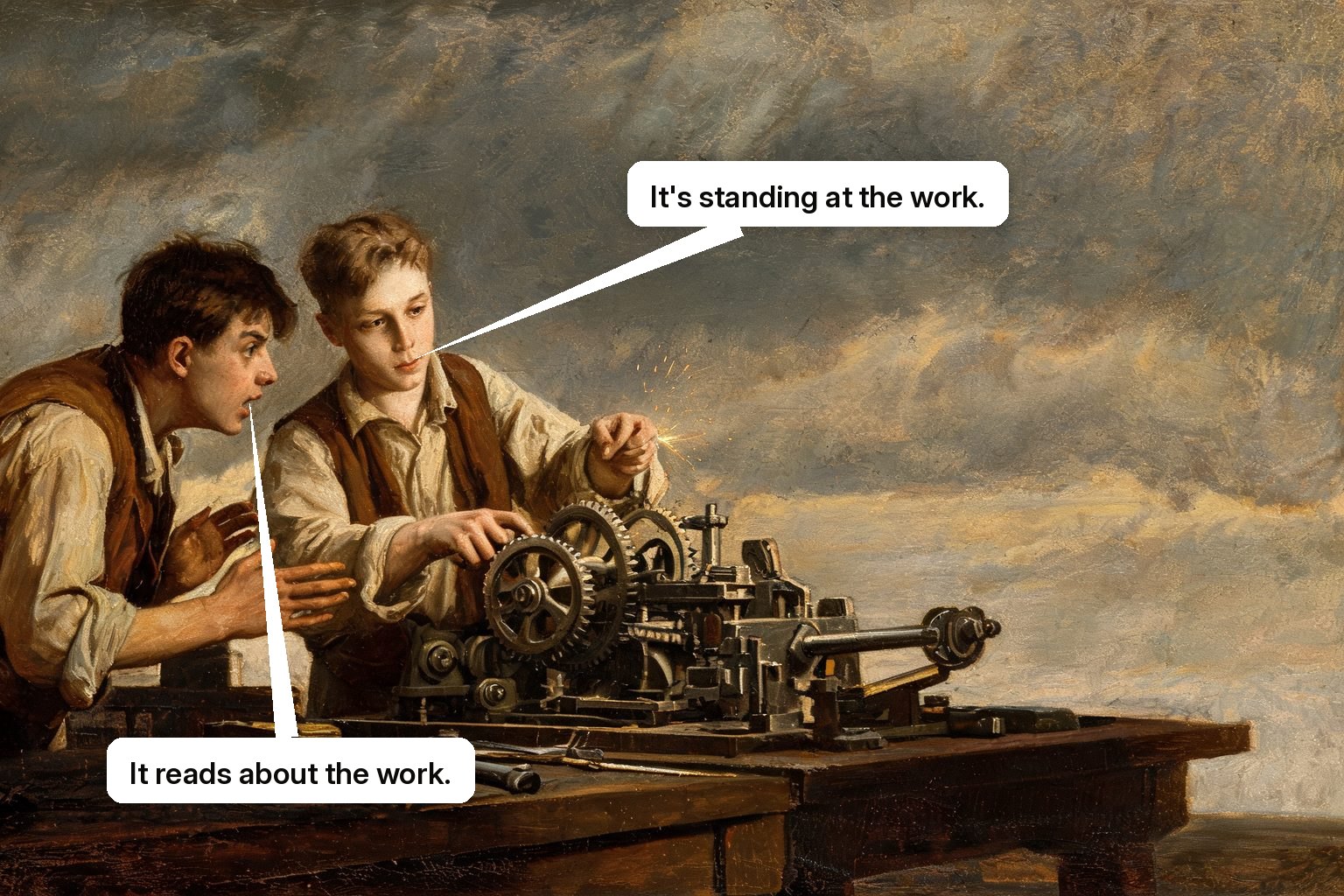
A live AI agent is an AI teammate that talks with users in real time, sees their screen, and takes actions in the product, working a continuous session with an agenda rather than answering one question at a time. The category's fullest expression is live AI employees: agents that do this across the customer lifecycle, from first demo to renewal.
What separates "live" from other AI agents?
The word live is doing precise work. It excludes recorded and authored experiences: a captured product tour or a pre-rendered video is an artifact, fixed at publish time, however much AI helped produce it. It excludes chat-only assistants: a bot that answers typed questions but cannot see the user's screen or act in the product is a knowledge interface, not a live agent. And it excludes offline automation: an agent that processes queues in the background does real work, but not with a user, in a shared moment, on a shared screen. Live means the agent and the user are in the same session, at the same time, looking at the same thing, and the agent can talk, see, and act there.
What capabilities define the category?
Four, and the definition requires all of them together. Voice: real-time spoken conversation, interruptible, multilingual. Eyes: perception of the user's actual screen and product state, which page, what's configured, where the user is stuck. Hands: the ability to act in the product, annotate, click, fill, configure, with permission. Brain: grounding in the business's knowledge, memory of the account, and the ability to plan multi-step work. Remove any one and you get a familiar, lesser thing: voice without eyes is a phone call from someone who's never seen your app; eyes without hands is analytics; everything without memory is a quick hit that forgets you at the window's close.
What makes a session different from an interaction?
A session is a continuous working engagement with an agenda: a plan, tracked progress, and the ability to resume, across a 45-minute call or across four short sittings in a week. An interaction is a single turn: question in, answer out, context gone. The session is the category's real dividing line, because it's what lets a live agent finish jobs, run a demo with a storyline, onboard an account across its first days, resolve an issue end to end, rather than merely answer questions about those jobs.
Where did the category come from?
Live agents are a synthesis, not a single invention: chat matured first, then real-time voice, then screen perception and computer-use action, each an industry-wide wave. The one-line history: chat answered questions; voice made it conversational; eyes and hands made it capable; live made it an employee. (Disclosure: we build Skippr, whose live AI employees, Skippr AI demo, Skippr AI onboarding, Skippr AI technical support, and Skippr AI training, work the customer lifecycle end to end; the definition above is the category's, not ours alone.)
Questions buyers actually ask
What is a live AI agent in one sentence?
An AI teammate that talks with users by voice, sees their screen, and takes actions in the product, working continuous, agenda-driven sessions rather than single-turn exchanges.
Is a live AI agent the same as a chatbot?
No. A chatbot answers typed questions and cannot see the screen or act. A live agent converses in real time, perceives the actual interface, acts with permission, and holds a plan across sessions.
What's an example of a live AI agent at work?
An onboarding agent that runs a voice kickoff, configures the account with the user on their own screen, and resumes the plan two days later where it left off.
See what a live agent actually does
The category is easier to watch than to define. Fifteen minutes is enough to see where the mechanism differs from everything it gets confused with.