
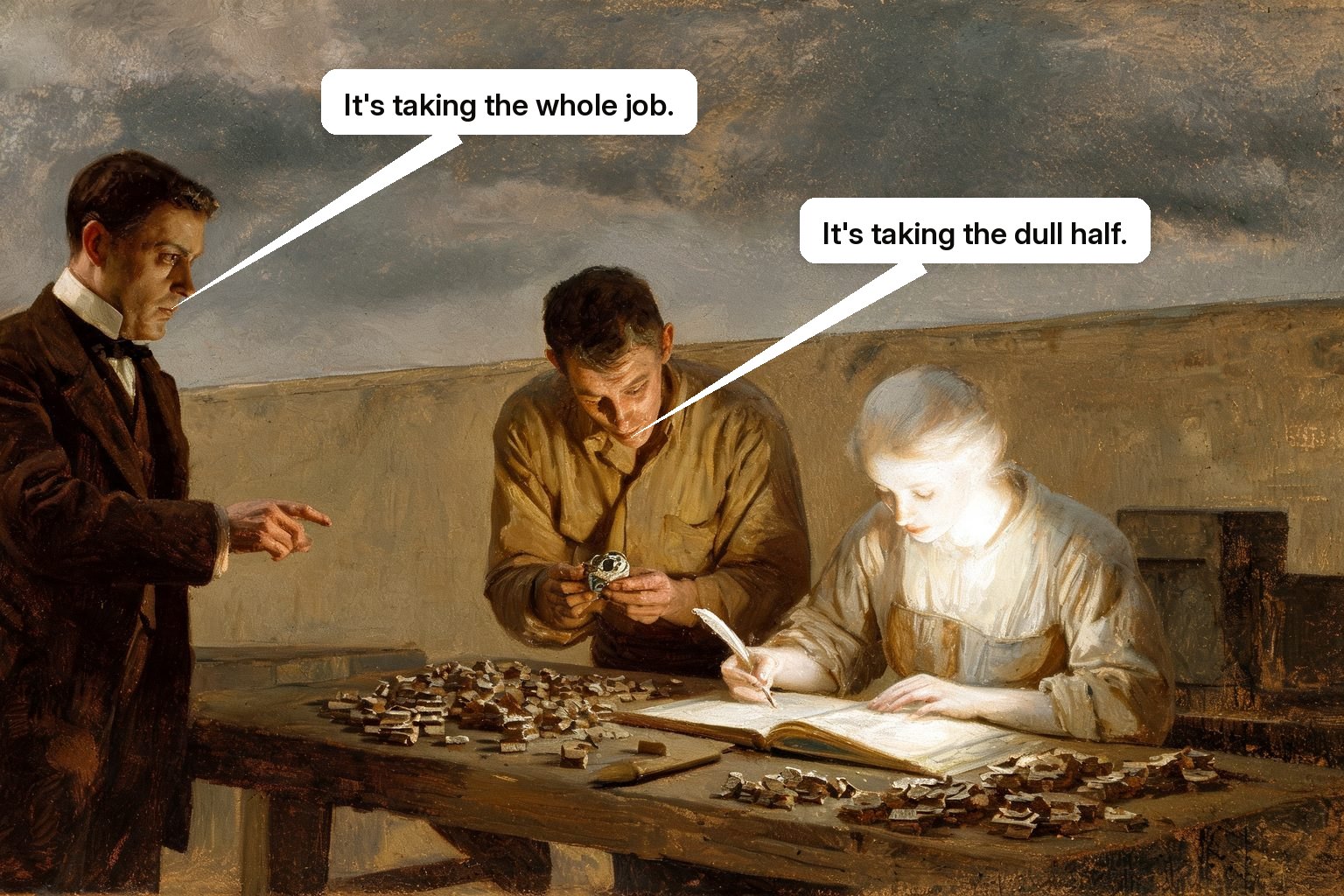
AI employees are AI agents that hold a job rather than a function: a named role, a set of outcomes they're measured on, sessions they run with real users, and membership in a team that shares memory. The term earns its noun when the agent works the way a colleague does, not when a chatbot gets a human name and a headshot.
What makes an agent an employee?
Four properties, all testable. A role: not "answers questions" but a job a human would recognize, runs demos, onboards accounts, resolves support issues, trains users, with the judgment boundaries of that job written down. Outcome accountability: measured on what the role exists to produce, qualified meetings, time-to-value, resolutions, users trained, not on activity like sessions held or messages sent. Session-grade work: an employee works a meeting with an agenda and picks up where they left off; quick-hit tools have interactions, employees have sessions. Team membership: the work product lands where colleagues can use it, notes in the CRM, context handed to the next role, escalations documented, because a worker whose output evaporates isn't employed, they're just present.
What AI employees are not
Not rebranded chatbots: a name and an avatar on a Q&A widget changes the marketing, not the mechanism. Not copilots: a copilot assists you with your task inside your tool; an AI employee carries its own task with your customer. Not RPA or background automation: scripted back-office processing does valuable work, but nobody's confused about whether a batch job is a teammate. And not a replacement for human judgment: the honest version of the category keeps humans in the loop by design, hard calls escalate with full context, and the employee documents what it hands over. Vendors blur these lines because "AI employee" polls well; the four properties above are how you audit the claim.
Why the employment framing matters practically
Because it changes how you deploy and manage the thing. You give an employee a scope of work, not a script; you review their outcomes, not their transcripts (though you can); you design their escalation paths and their handoffs the way you would for a new hire. Teams that treat an AI employee like a feature configure it once and wonder why it plateaus; teams that treat it like a hire, onboard it on their knowledge, review its work weekly, widen its scope as trust grows, get compounding value, because the mechanism rewards management the way people do.
Where the category is today
The strongest current expression is live AI employees for the customer lifecycle: agents that talk, see the screen, and act in the product, working demo, onboarding, support, and training as one team with one memory of the account. (Disclosure: that's what we build at Skippr, four named agents, each measured on its role's outcome; the audit questions above apply to us first.)
Questions buyers actually ask
Are AI employees meant to replace people?
The credible version replaces the rationing, the coverage no team could staff, while humans keep the judgment work, with escalation designed in rather than bolted on.
How is an AI employee different from an AI agent?
Every AI employee is an agent; the employee framing adds a role, outcome accountability, session-grade work, and team membership with shared memory.
How should we evaluate an " AI employee " claim?
Ask for the role's outcome metric, watch a resumed session, and inspect what lands in your systems after it works. Names and avatars prove nothing.
See what a live agent actually does
The category is easier to watch than to define. Fifteen minutes is enough to see where the mechanism differs from everything it gets confused with.