
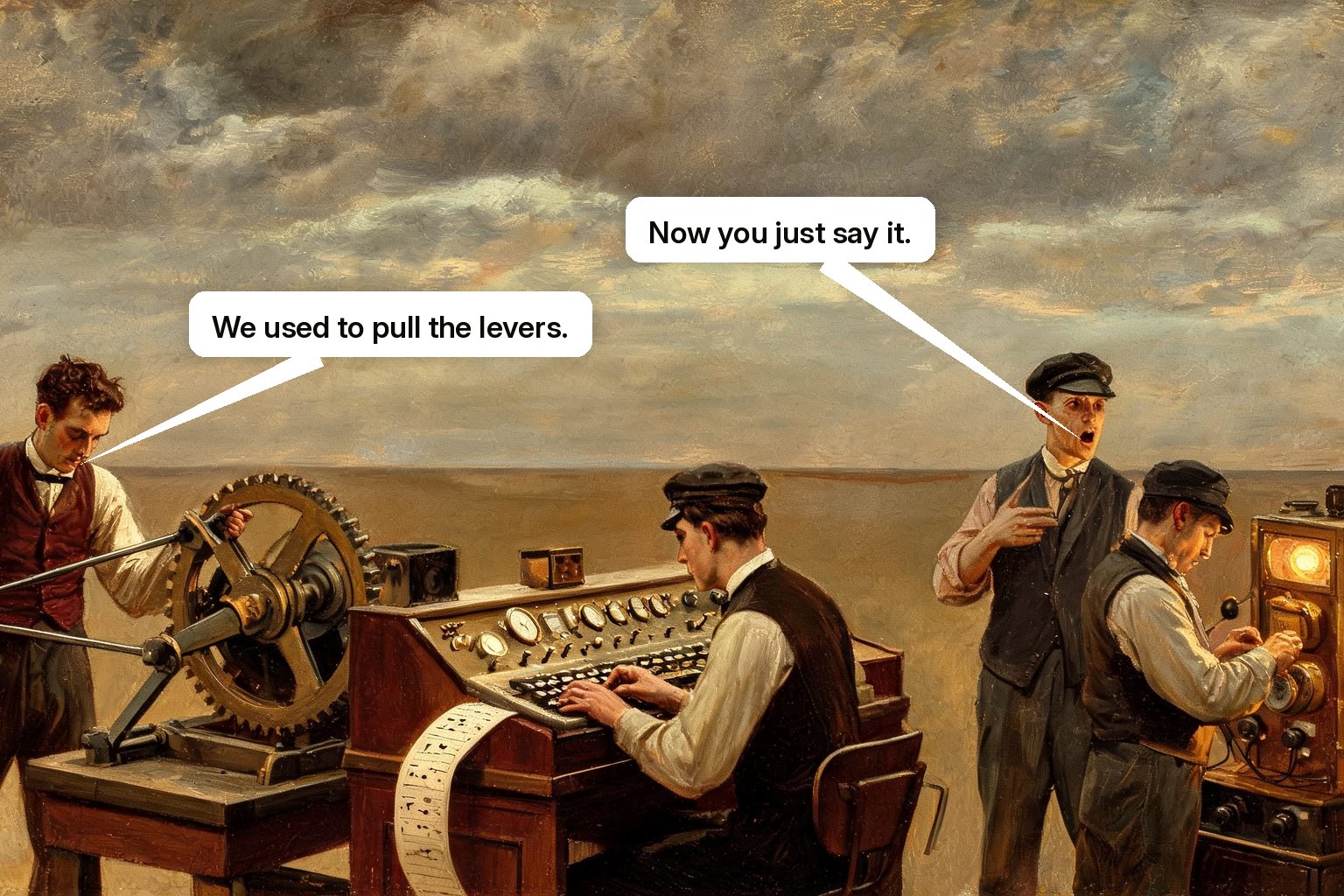
Every interface in computing history is a treaty about who does the translating: humans learning the machine's language, or the machine learning ours. For seventy years the treaty moved one direction, slowly, and the last decade broke it open. A short history of talking to computers is really a history of who carries the translation burden.
The command era: we learned theirs
First we spoke machine outright, punch cards, then command lines: exact syntax, memorized verbs, the human as compiler. The GUI softened the treaty without changing its direction: point-and-click replaced memorization with recognition, but the human still translated intent into the machine's grammar of menus and buttons, just with pictures. Search cracked the door: for the first time, ordinary words in, useful things out, though only for one job (finding), and with the machine still innocent of meaning, matching strings, ranking links, understanding nothing.
The conversation era: they started learning ours
Chatbots and assistants were the first genuine reversal, natural language in, natural language out, and the early versions taught everyone the gap between parsing words and understanding intent. LLMs closed most of that gap for text; real-time speech models then made it conversation in the full social sense: interruptible, tonal, multilingual mid-sentence. By this point the machine had learned our language remarkably well. What it hadn't learned was our situation: it could discuss anything and see nothing, advise fluently on a screen it couldn't perceive, forget everything at the window's close. Talking had been solved; talking about the thing in front of us had not.
The colleague era: language plus situation
The current stage adds what conversation alone lacked: eyes on the shared screen, hands that act in the software, memory that persists, an agenda that structures the work. That combination changes the treaty's nature, not just its terms: for the first time the computer participates in the situation rather than commenting on it, and "talking to computers" starts meaning what talking to a colleague means: same context, shared task, both parties able to point at the thing and do something about it. The one-line version of the recent chapters: chat answered questions; voice made it conversational; eyes and hands made it capable; live made it an employee.
What the arc suggests comes next
Each era shrank the translation burden and widened who could use computing at all, the GUI let in millions the command line excluded; conversation let in everyone the GUI still confused. The colleague era's version of that widening is underway: expertise itself becoming ambient, every user working alongside something that knows the software so they don't have to. Software that must be learned is starting to look like a historical phase. (Disclosure: we build the colleague era's customer-facing edge at Skippr; the history, though, belongs to everyone who moved the treaty our way.)
See what a live agent actually does
The category is easier to watch than to define. Fifteen minutes is enough to see where the mechanism differs from everything it gets confused with.