
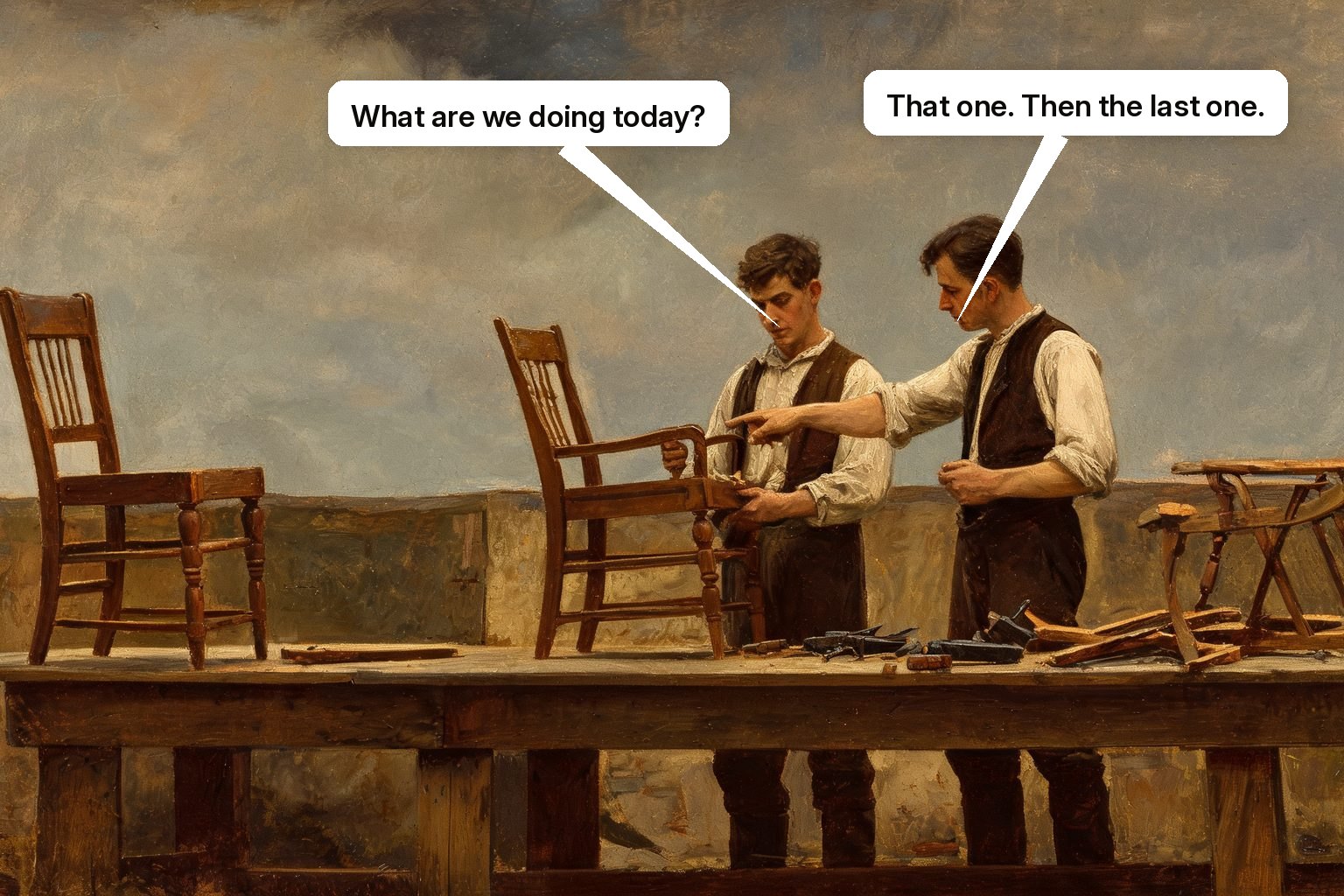
An agenda-driven AI session is a continuous working engagement in which the agent holds a plan, a storyline for a demo, a setup sequence for onboarding, a curriculum for training, tracks progress against it, and can pause and resume without losing its place. The agenda is what separates finishing jobs from answering questions.
The definitions, precisely
A session is the unit of engagement: a continuous stretch of joint work between agent and user, with a beginning, an intent, and an outcome, fifteen minutes or forty-five, in the product or on a call. An agenda is the plan the session serves: the objectives, their order, the milestones that mark progress, and the exit criteria that say what "done" means. Agenda-driven means the plan governs across time: today's session knows what Tuesday's accomplished, what was deferred, and what remains, so work spanning days behaves like one engagement rather than a series of introductions. The contrast term is the quick hit: a single-turn exchange, question in, answer out, context evaporating at the window's close.
What holding an agenda actually requires
More than scheduling. Progress state: knowing which milestones are confirmed, on the account's real configuration, not assumed from a checklist. Flexible firmness: absorbing the user's tangent, the interruption, the twenty-minute detour their question deserves, and then returning to the plan, a plan held firmly and worn lightly. Resumption: session two opens where session one ended, no recap, no re-explaining, which demands durable memory of the account, not the conversation buffer. And exit honesty: knowing when the agenda is complete versus abandoned, and what to do about the difference (nudge, wait, escalate). Quick-hit tools can fake the first session; the tell is always the second, ask any vendor to show you session two.
Why the agenda is the hard capability
Perception, voice, and action are capabilities of the moment; the agenda is a capability of time, and time is where the valuable jobs live. Onboarding doesn't fit in one sitting; a serious evaluation spans stakeholders and rounds; a curriculum consolidates across spaced practice. Every one of those jobs is trivially describable and operationally brutal without a plan that survives interruption, absence, and change. It's also the hardest thing for single-turn architectures to retrofit, which is why "session" deserves to be a term of art and not a synonym for "conversation."
How the term should be used
Reserve session for engagements with an agenda and memory; call everything else an interaction. The vocabulary discipline matters because buyers are sold "sessions" that are chat windows with a longer scroll. (Disclosure: agenda-driven sessions are the spine of every Skippr agent, a demo with a storyline, onboarding across days, training across a curriculum, and the session-two test is the one we most enjoy taking.)
Questions buyers actually ask
What's the difference between a session and a conversation?
A conversation is exchange; a session is exchange in service of a tracked plan, with progress, resumption, and a defined finish line.
How long is a typical session?
As long as the agenda segment needs: fifteen-minute onboarding sittings, forty-minute technical demos. Length follows the plan, not a timeout.
What happens when a session is interrupted?
The agenda persists: progress is saved at the milestone level, and the next session resumes exactly there, which is the capability's whole point.
See what a live agent actually does
The category is easier to watch than to define. Fifteen minutes is enough to see where the mechanism differs from everything it gets confused with.