
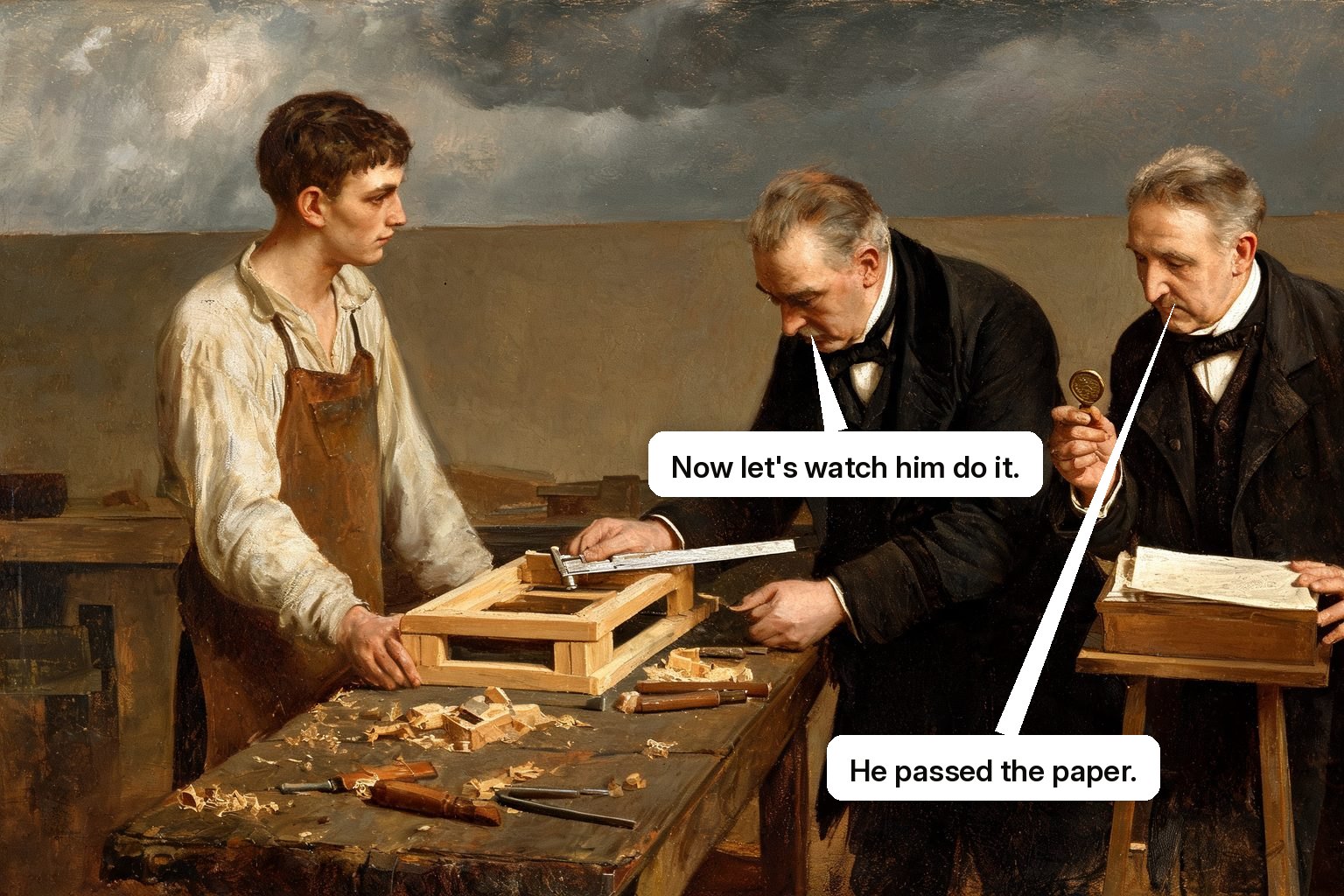
Certification has always run on proxies: the course completed, the quiz passed, the badge issued. AI-verified certification replaces the proxy with the act itself, a user performing the real workflow, in the live product, observed and scored by an agent that watched every step. It turns "certified" from a claim about attendance into a fact about capability.
What's wrong with badge-by-quiz?
A multiple-choice quiz certifies recognition, not performance. Everyone in enablement knows the failure case: certified on paper, lost in the interface. The proxy problem compounds downstream, partner programs, compliance audits, and customer admin certifications all inherit credentials that measure something adjacent to the skill. The reason we settled for proxies was practical: witnessing real performance required a human assessor per candidate, which scaled exactly as badly as you'd think.
How in-product verification works
An AI training agent runs the certification as a session. The candidate performs the target workflow, building the report, configuring the integration, processing the case, in the product (or its practice mode), on realistic data. The agent watches the screen throughout: sequence, accuracy, recovery from errors, time-in-task. It can probe ("why that setting?") by voice, exactly as a human assessor would. The outcome is a scored, evidenced record: performed unassisted, performed with prompts, or not yet, with the specific gaps named. Because the agent tracks each candidate's agenda over time, failed criteria route straight into the next practice session rather than a retake queue.
What it unlocks operationally
Four things. Trustworthy internal fluency data: managers see who can actually do what, per workflow, per team, real skill inventory instead of course-completion wallpaper. Customer-facing certification programs that mean something: certifying customer admins on real operations reduces support load and anchors renewal conversations in demonstrated capability. Partner enablement with teeth: a partner cert backed by observed performance protects your brand in ways a slide-deck cert never did. Compliance evidence: where process training must be provable, an evidenced performance record beats an attendance log in any audit. And because verification lives in the product, the certification stays current: when the workflow changes, the cert criteria change with it, no stale badge problem.
Getting started without boiling the ocean
Pick one workflow where "certified but can't do it" visibly hurts, usually the one generating repeat support tickets or fumbled demos. Define performed-unassisted criteria with the people who do it best. Run AI-verified certification on one team, compare their downstream metrics (tickets filed, task time, error rate) against the quiz-certified baseline, and let the delta make the budget argument. (Disclosure: this is Skippr's Skippr AI training in certification mode, "measured on users trained" was always meant literally.)
Questions buyers actually ask
Is AI-verified certification fair to test-anxious users?
Fairer than quizzes, generally: it assesses the actual job in the actual context, allows multiple observed attempts, and names specific gaps instead of issuing a pass/fail verdict.
Can it certify skills in regulated workflows?
It produces evidenced performance records, which strengthen compliance files, but map specific regulatory requirements with your compliance team before replacing mandated formats.
Watch it train someone
Completion is not competence, and the difference shows up in the product rather than the dashboard. Fifteen minutes is enough to tell them apart.