
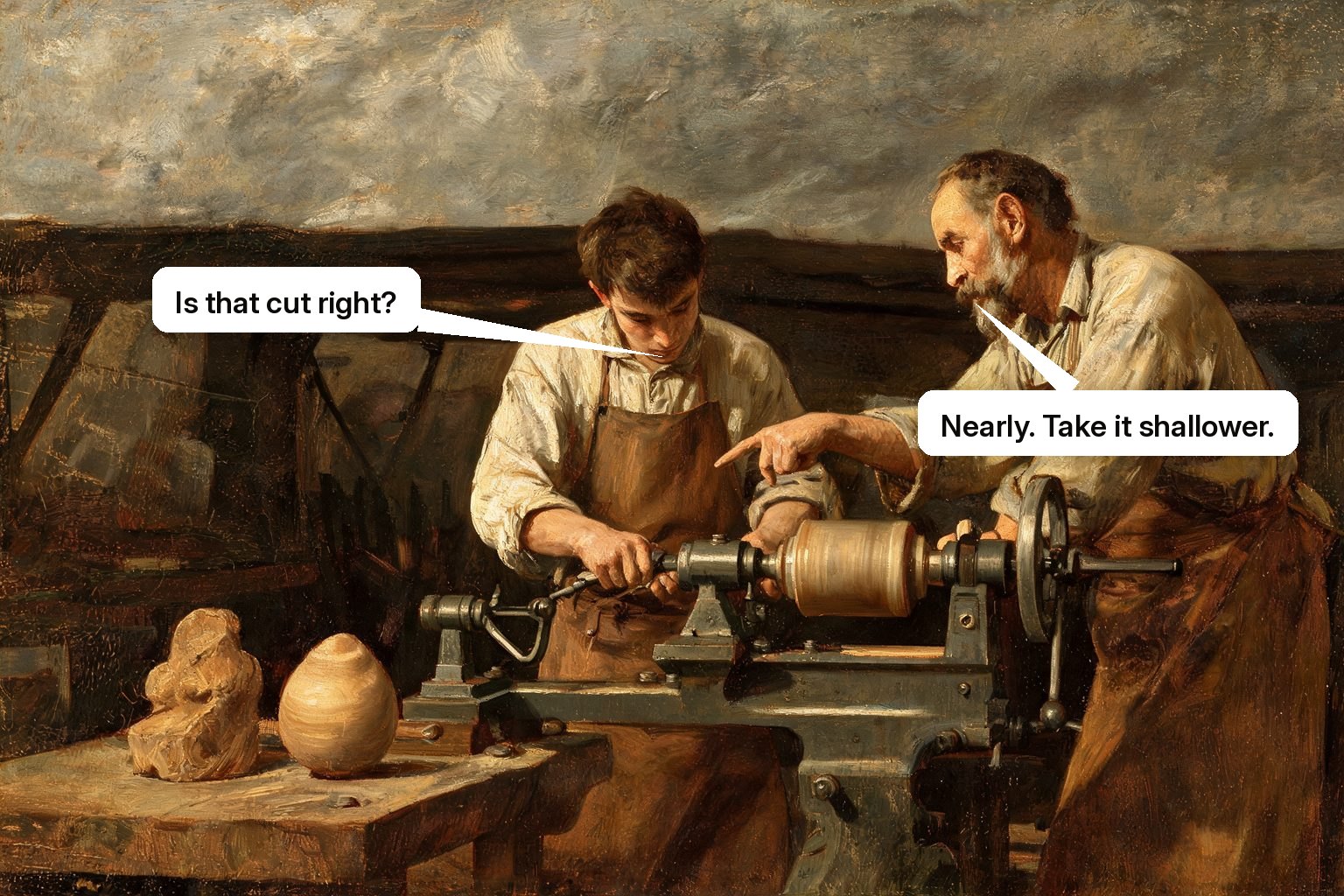
An AI trainer is an AI agent that teaches people to use software the way a human trainer would: it talks with the learner by voice, sees their screen, demonstrates workflows on the live product, supervises practice, and works through a curriculum across multiple sessions. It differs from tutorials, videos, and help assistants in one word: sessions.
The definition, precisely
Four capabilities make a trainer an agent rather than a content format. Perception: it sees the learner's live screen and product state, which page, what's configured, where the hesitation is. Conversation: real-time voice, in the learner's language, with questions answered in the moment. Action: it demonstrates on the actual interface, annotates, and guides the learner's own attempt rather than describing one. Agenda: it runs a curriculum, milestones per learner, short sessions spaced over days, each resuming where the last ended. Remove any one and you get something familiar but different: remove perception and it's a course assistant; remove action and it's a lecture; remove the agenda and it's a help widget.
What does a session with an AI trainer look like?
A support rep needs to learn the escalation workflow. Session one, fifteen minutes: the trainer demonstrates the flow on the rep's screen, narrating decisions, then watches the rep run it in practice mode on a realistic case, correcting one wrong turn. Two days later, session two opens where one ended: a harder case, an exception path, no prompts this time. The trainer records the outcome, performed unassisted, and moves the agenda to the next workflow. Nobody watched a video. Nobody left the product. The learner did the thing, twice, under supervision, and the record shows it.
What an AI trainer is not
It is not a tooltip tour: tours point at locations; trainers teach procedures and watch them performed. It is not a training video: video is fixed at render time and can't see the learner's messy real account. It is not the previous generation's chatbot bolted onto a course library: answering questions about content is a quick hit; training is a plan being kept across days. The tell is always the same: ask whether the mechanism can supervise an attempt and resume a plan.
How do you evaluate one?
Ask a vendor to show you session two, the one that remembers what was practiced on Tuesday, knows what's next, and adjusts for the learner who struggled. Quick-hit tools can't fake that demo. Then ask what the agent does when the learner performs the workflow wrong, and what record exists afterward. (Disclosure: Skippr's Skippr AI training is built on exactly this session model, video-call sessions plus an always-on practice mode in the product, measured on users trained; the questions are worth asking of anyone, including us.)
Questions buyers actually ask
Is an AI trainer the same as an AI course generator?
No. A generator produces content faster; the learner still consumes it alone. An AI trainer delivers the training itself: live demonstration, supervised practice, and a per-learner agenda across sessions.
Can an AI trainer handle complete beginners?
Beginners are the strongest case: the trainer paces to the learner, answers the questions a video can't hear, and lets them practice safely before working live.
Watch it train someone
Completion is not competence, and the difference shows up in the product rather than the dashboard. Fifteen minutes is enough to tell them apart.