
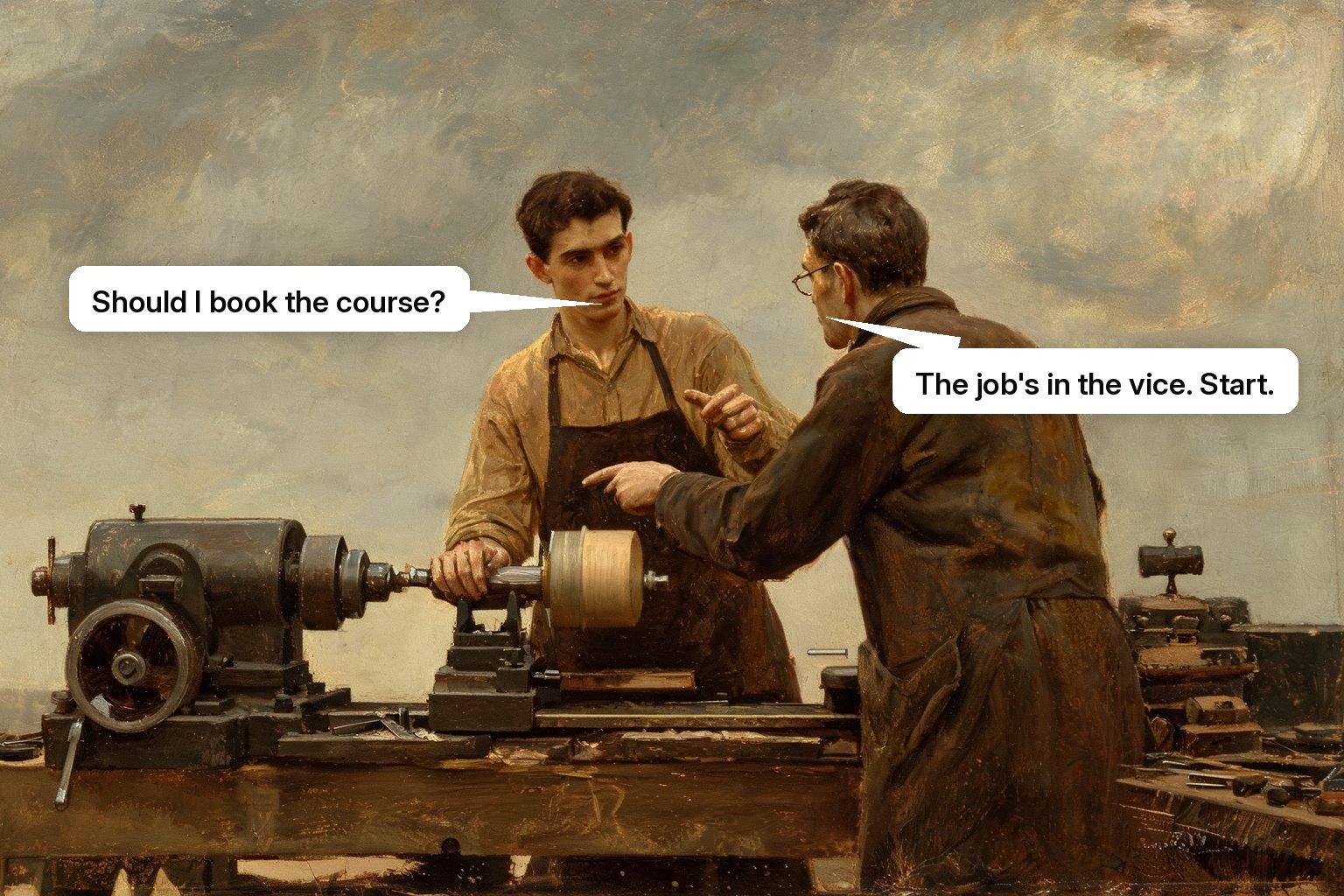
In-product training teaches users your software inside the software itself: demonstrations on the learner's own screen, guided first use with their real data, and supervised practice, instead of classrooms, videos, or slide decks that describe the product from a distance. It works because it deletes the transfer gap, the distance between where a skill is learned and where it must be performed.
Why does training location matter so much?
Because software skills don't travel well. A century of learning research on transfer says the same rude thing: skills learned in one context show up weakly in another, and the loss grows with the distance between contexts. Software maximizes the distance problem: the skill is a procedure bound to an interface's exact states and edge cases, and the interface itself changes monthly. A workshop about the product is training for a place other than where the work happens. Users sense this, which is why the workshop scores well and changes nothing on Thursday.
What does in-product training look like in practice?
Three moves, in order. Demonstration: the trainer shows the workflow on the learner's own screen, their account, their data, their configuration, narrating the decisions, not just the clicks. Guided first use: the learner performs the workflow immediately, with the trainer watching and correcting in the moment, the wrong turn caught at the turn, not in a quiz next week. Supervised practice: repetitions in a safe practice mode, spaced across days, until the workflow is performed unassisted. Each move happens where the skill will live. There is nothing to transfer, because nothing was learned anywhere else.
What still belongs outside the product?
Be honest about the boundary. Concepts, strategy, and "why" material, what the product is for, how your methodology works, travel fine in video and docs, and video does them with polish that a live session doesn't need to match. Conversations, negotiation, and discovery skills belong in roleplay, not interfaces. The rule of thumb: if the skill is performed on a screen, teach it on that screen; if it's performed in a meeting or in the head, teach it where it lives instead.
How do you deliver it at scale?
This was always the catch: in-product teaching used to mean a patient expert at every learner's side, which priced it out of everyone's reach except enterprise onboarding projects. A live AI training agent removes the constraint: it sees each learner's screen, demonstrates, supervises practice, and carries a per-learner agenda, simultaneously, for every user who needs it. (Disclosure: this is what Skippr's Skippr AI training does, sessions on video calls plus an always-on practice mode in the product; the pedagogy is old, the staffing just became possible.)
Questions buyers actually ask
Is in-product training the same as product tours?
No. Tours point at interface locations on a fixed path. In-product training demonstrates procedures, watches the learner perform them, and adapts to their account and pace.
Does in-product training work for complex enterprise software?
Complexity is where it earns most: the deeper the product, the more expensive the transfer gap, and the more valuable supervised practice on real workflows becomes.
Watch it train someone
Completion is not competence, and the difference shows up in the product rather than the dashboard. Fifteen minutes is enough to tell them apart.