
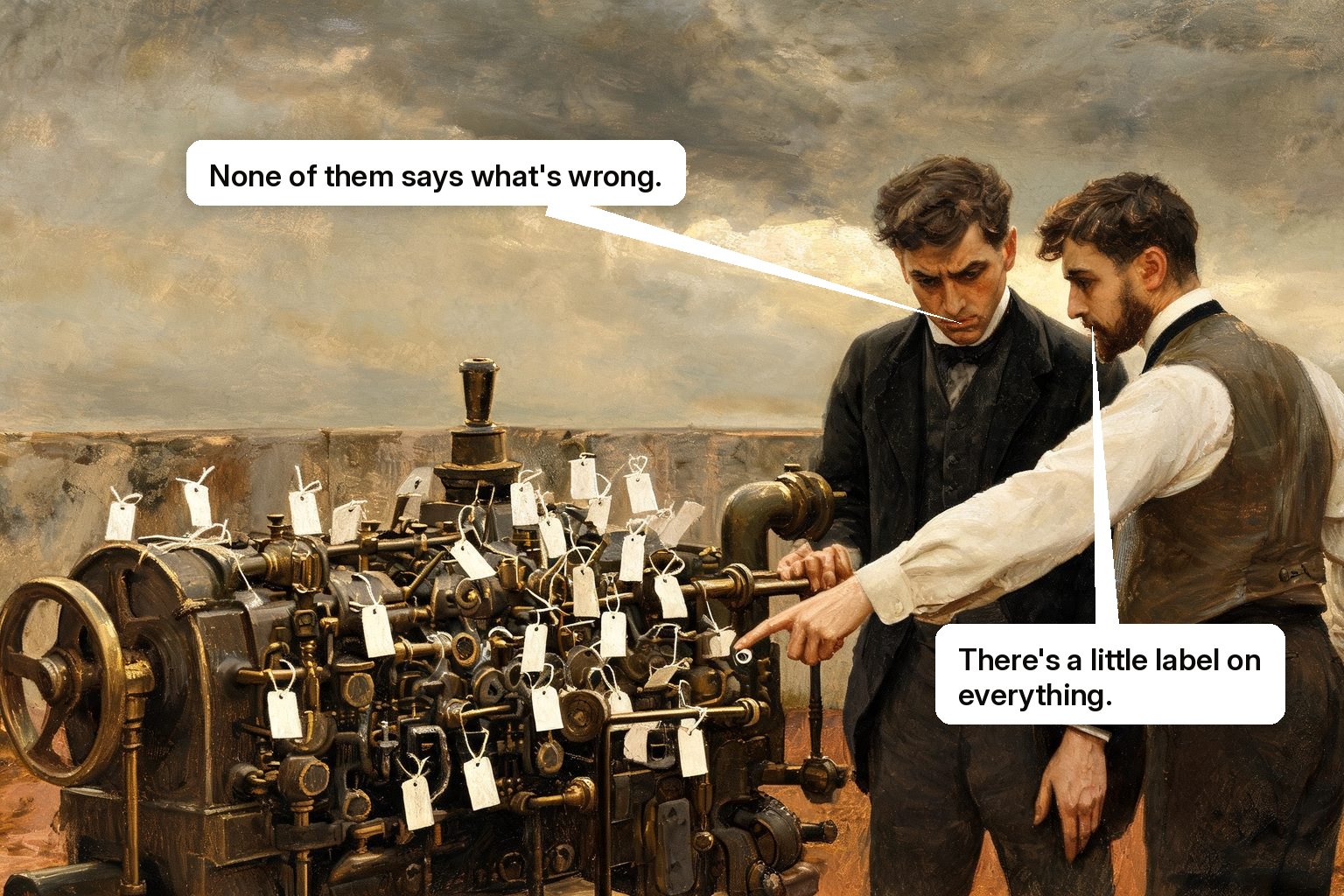
The tooltip is the most deployed teaching device in software, and the least examined. Adoption platforms have spent a decade instrumenting products with hotspots, beacons, and walkthrough bubbles on the theory that pointing is teaching. Usage data keeps delivering the verdict: users dismiss, tunnel past, and forget. Pointing was never teaching.
What a tooltip can and cannot do
Be fair to the mechanism first: tooltips are excellent at labeling, telling a user what a control is called at the moment they hover near it. Orientation, micro-copy, a nudge toward a new button: legitimate work, honestly done. The overreach began when labeling was asked to carry learning: sequenced walkthrough bubbles standing in for actual instruction on multi-step, judgment-laden workflows. A workflow isn't a set of locations on a screen; it's a procedure with decisions, states, and failure modes. You cannot annotate someone into a procedure. Ask anyone who has clicked "Next" nine times through a walkthrough and retained nothing but a vague sense of having been somewhere.
Why the learning doesn't stick
Three reasons, all structural. No retrieval: learning consolidates when the learner actively produces the action, not when they watch a bubble describe it, the tooltip tour is passive by design, so it evaporates on schedule. No feedback: a real trainer watches the learner try, catches the wrong turn, and corrects it in the moment; a tooltip sequence has no idea the user just did the step wrong, and cheerfully advances. No adaptation: the tour is authored once for everyone, the admin who needs depth and the end user who needs three basics get the identical nine bubbles. Passive, blind, and generic is a poor pedagogy trifecta, and no amount of better targeting rules fixes what the mechanism can't perceive.
Instrumenting software vs teaching people
This is the honest boundary line in the adoption category. Adoption platforms instrument the software: they overlay guidance, measure usage, and surface analytics, genuinely valuable, especially at enterprise scale, and the incumbent platforms do it with real sophistication. Teaching people is a different job: demonstration on the learner's own screen, supervised practice with correction, spaced sessions that build toward demonstrated competence. That job requires eyes, voice, hands, and an agenda, a trainer, not an overlay. The two can coexist in a stack; the mistake is buying the first and believing you've solved the second. (Disclosure: the second job is what we build, Skippr's Skippr AI training, so audit our claim the same way: ask any vendor to show you a user performing the workflow unassisted after their mechanism ran.)
The test your adoption data can run tonight
Pick your most important tooltip walkthrough. Pull two cohorts: users who completed it, and users who never saw it. Now measure actual workflow performance, completion, error rate, time-in-task, a week later. If the cohorts look the same (they usually do), the walkthrough is labeling, not teaching, and the gap between your adoption dashboard and your competence reality is the size of the opportunity.
Watch it train someone
Completion is not competence, and the difference shows up in the product rather than the dashboard. Fifteen minutes is enough to tell them apart.