
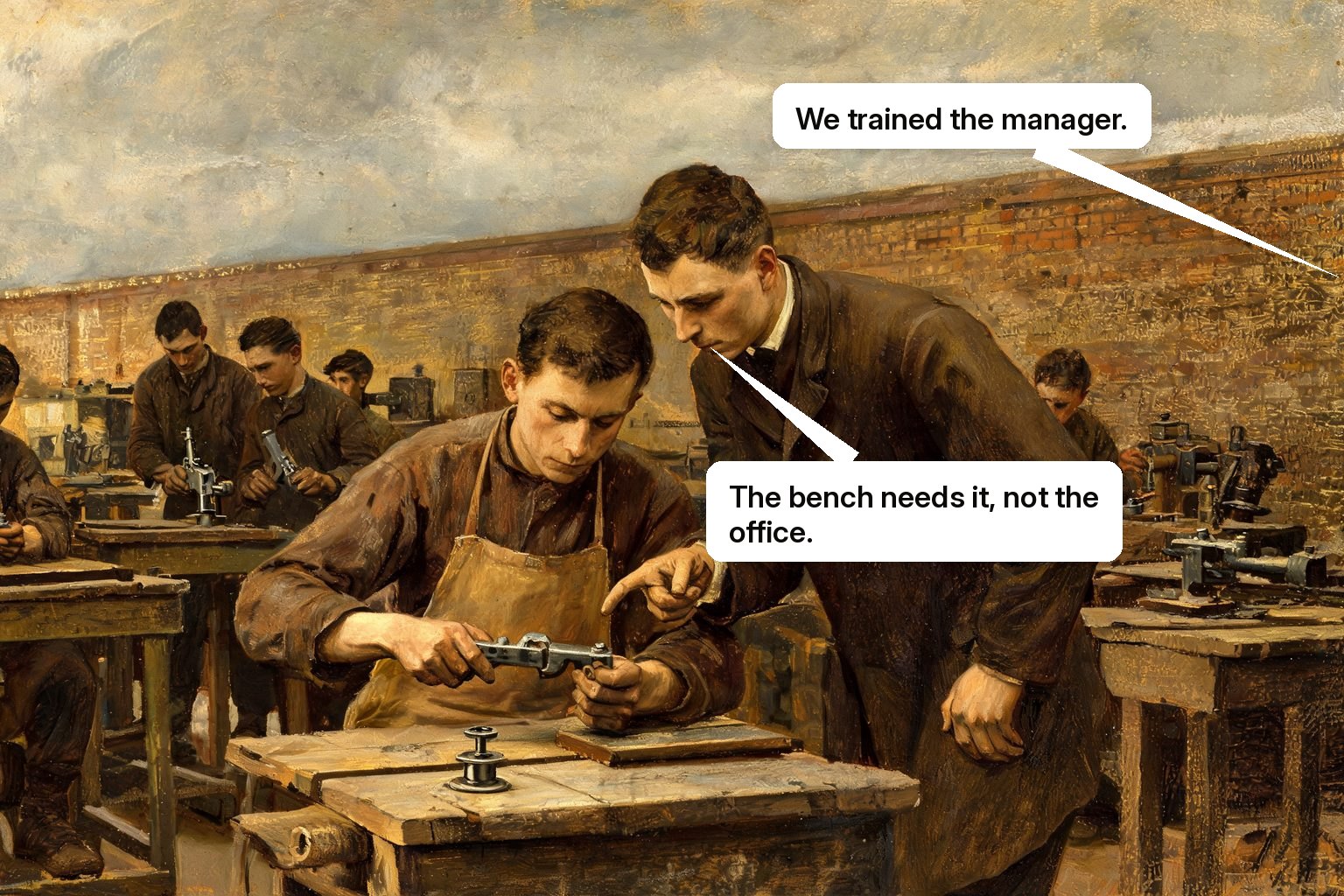
Most software rollouts train one person: the admin who attended the vendor sessions. Everyone else gets a launch email and a PDF, and the tool's fate is decided by whether the admin has spare time to teach. Rolling out to everyone means role-based, hands-on training for every affected user, which AI trainers make operationally possible for the first time.
The train-the-trainer pyramid, and why it collapses
The standard rollout model is a relay: vendor trains the admin, admin trains the team, team trains itself through osmosis. Every leg loses signal. The admin learned the whole product but teaches what fits in one meeting; the meeting recording answers nobody's actual questions; and six weeks later usage has settled onto the three features the loudest early adopter happened to like. The pyramid wasn't a pedagogy; it was a budget shape. Hands-on training for two hundred end users was never going to fit in the implementation plan, so the plan quietly redefined "trained" as "invited to the webinar."
Step 1: Cut the rollout into role-based agendas
The admin needs configuration depth; the manager needs the reporting views; the end user needs a handful of workflows done fluently. Write the agenda per role, with the finish line defined as performance: this role can do these workflows unassisted. Resist the single all-hands curriculum, it's the pyramid in a new shirt, teaching everyone the admin's product.
Step 2: Train in parallel, not in cohorts
A live training agent removes the scheduling constraint that created the pyramid: every user gets their own short session, on their own screen, in their own language and timezone, the same week. The struggling user gets forty minutes, the quick one gets twelve, nobody waits for a cohort or watches a recording of someone else's questions. Sessions resume, so the rollout survives contact with real calendars. The admin's role shifts from overloaded teacher to curriculum owner: they decide what each role must master and review the competence board as it fills.
Step 3: Verify before you call it rolled out
"Rolled out" should mean a coverage number: what share of affected users performed their role's core workflows, witnessed, unassisted. That number, per team, is the honest rollout dashboard, and it flags precisely where adoption will stall before the usage data has to tell you. It also changes the renewal conversation a year later: utilization arguments sound different when every seat was actually trained. (Disclosure: this is Skippr's Skippr AI training on rollout duty, parallel sessions, per-role agendas, users trained as the finish line; the pilot is self-service, so one team's rollout is a fair test.)
The cultural dividend
Teams remember whether software arrived with help or homework. A rollout where every person got a patient, hands-on session sets a different default for the next tool: less resistance, fewer folk workarounds, and no single admin holding the whole deployment's fate in their calendar.
Questions buyers actually ask
Isn't training everyone overkill for simple tools?
Scale the agenda, not the principle: simple tools need one short session per role. The failure mode isn't over-training; it's the untouched eighty percent who never got past the login.
What about users who refuse training?
Make it shorter and closer to their work: a fifteen-minute session on their own screen, at their moment, converts most refusers. Track deferrals separately from failures; they need different fixes.
Watch it train someone
Completion is not competence, and the difference shows up in the product rather than the dashboard. Fifteen minutes is enough to tell them apart.