
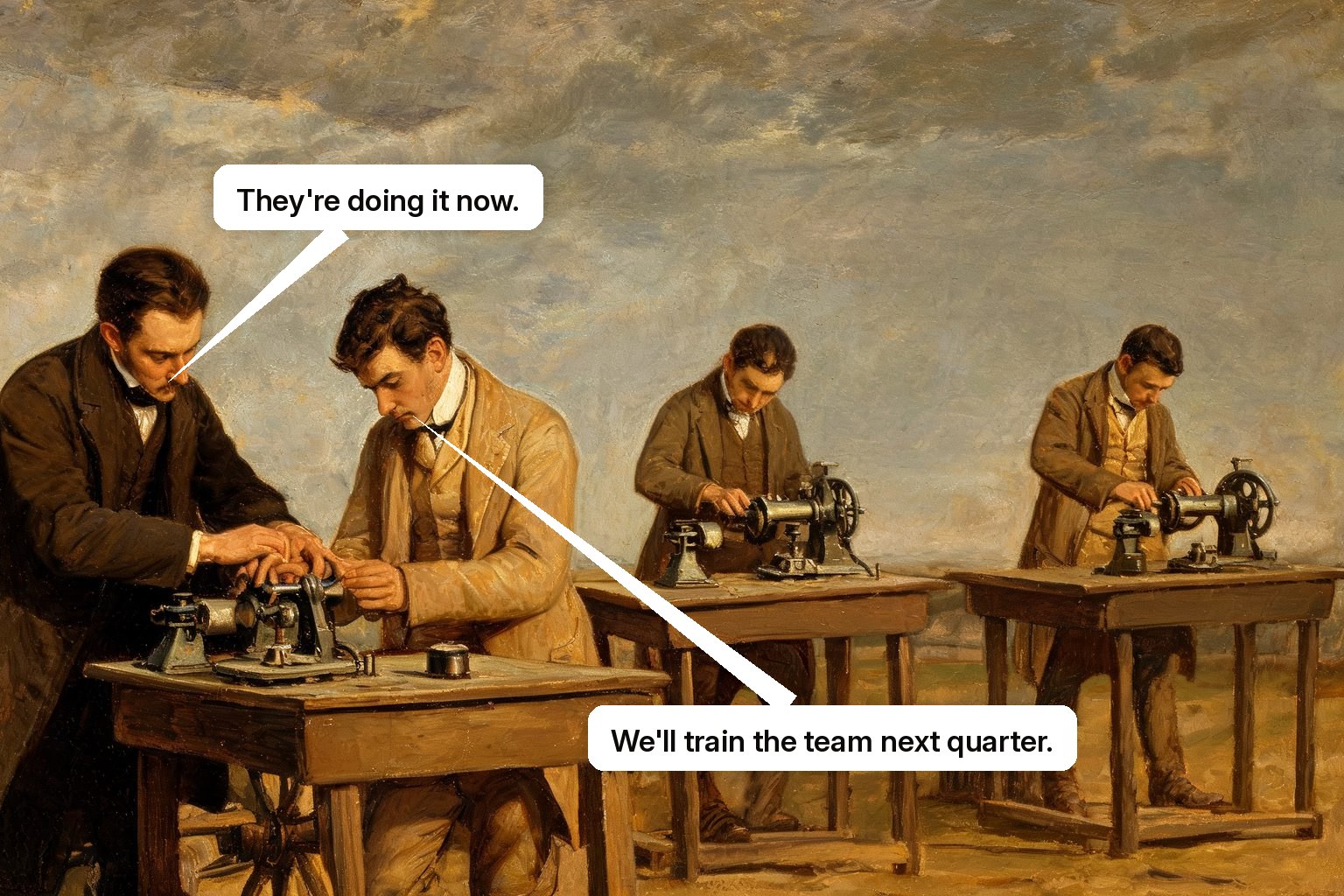
The launch is Monday. The pricing changed, the packaging changed, the demo flow changed, and two hundred reps across nine time zones need to be fluent by Friday. Every enablement leader knows this week. The bottleneck was never content creation. It's session throughput: one trainer, many learners, five days. AI changes the arithmetic.
The launch-week math that never worked
Do the numbers on classic enablement: two enablement leads, live sessions of twenty reps, everyone needing hands-on practice, questions, and a competence check, not a webinar they'll watch on mute. Even heroically scheduled, you get coverage or quality, never both, and never by Friday. So teams settle for the broadcast pyramid: a live session for the favored few, a recording for everyone else, a quiz to generate the illusion of verification. Fluency arrives eventually, unevenly, weeks after the market needed it. The cost isn't visible in the LMS; it's visible in the deals fumbled during the fluency gap.
What parallel training actually looks like
An AI training agent doesn't schedule; it multiplies. Every rep gets the same thing the favored twenty used to get, a live, hands-on session: the new flow demonstrated on their screen, practiced in practice mode against realistic scenarios, corrected in the moment, verified by performance rather than quiz. Except it happens simultaneously, in every timezone, in each rep's language, at each rep's pace, the struggling rep gets forty minutes, the veteran gets twelve, nobody waits for the cohort. Enablement leads stop being session machines and become curriculum designers: they set the agenda Monday morning, monitor competence dashboards through the week, and spend their live hours on the reps the data flags. By Friday, "trained" is an audited list, not a hope. (Disclosure: this is Skippr's Skippr AI training in its enablement role, and the self-service point matters here: a motion like this should be testable on one team this month, not gated behind a two-quarter rollout.)
The strategic unlock hiding in the logistics
Speed-to-fluency isn't an ops nicety; it's a competitive weapon. The company whose entire field is fluent in week one of a launch competes against companies still scheduling sessions in week four. And once training throughput is effectively infinite, product and GTM planning changes too, you can ship the bolder packaging change, because "can we train everyone in time?" stops being a veto. Enablement at AI speed doesn't just train reps faster. It removes a brake the whole company forgot it was riding.
Watch it train someone
Completion is not competence, and the difference shows up in the product rather than the dashboard. Fifteen minutes is enough to tell them apart.