
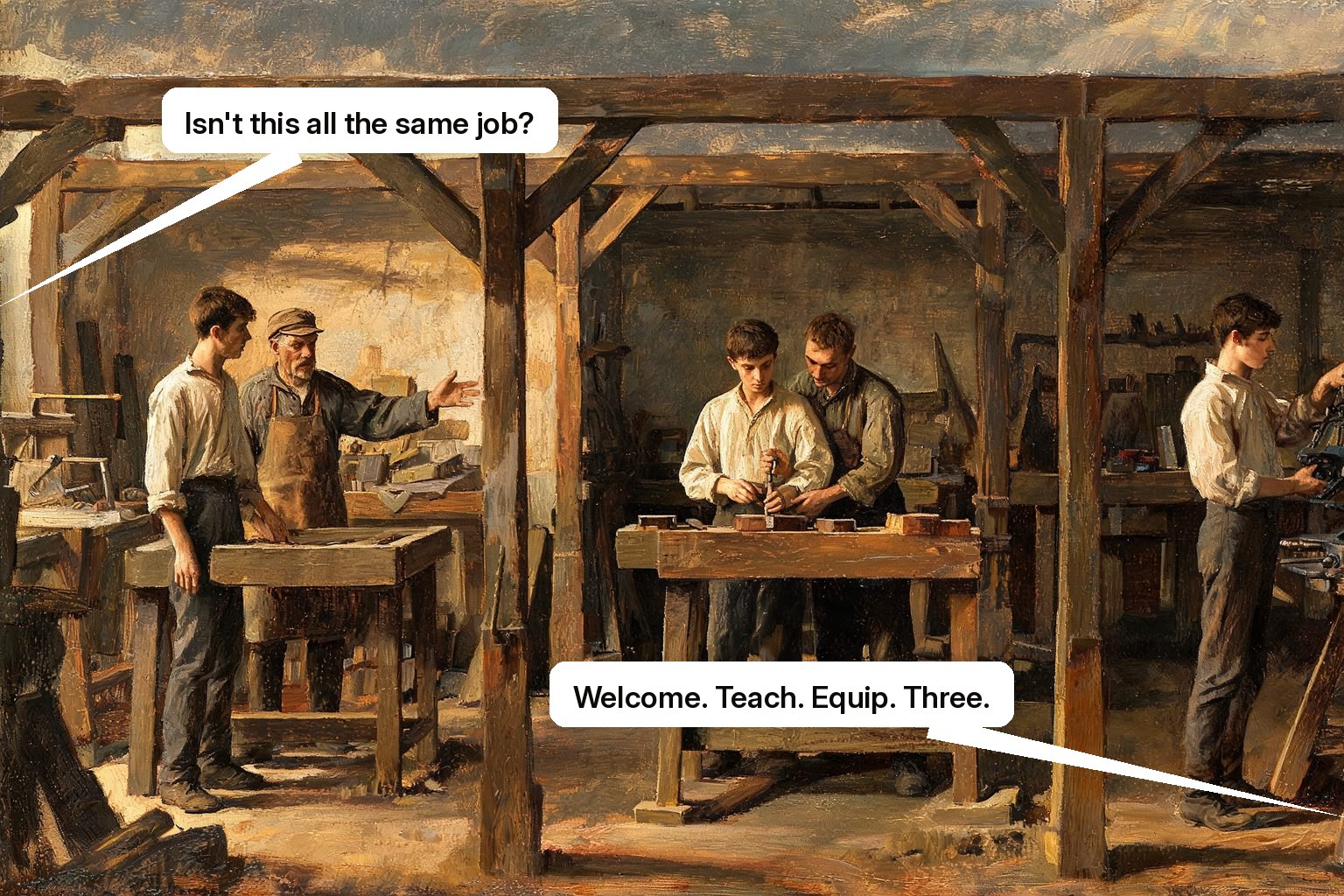
Onboarding takes a new customer from signup to first value. Training builds durable skill on your product, for customers and for internal teams. Enablement equips customer-facing employees, sellers, support, CS, with the knowledge and tool fluency to do their jobs. They blur because they share one underlying activity, teaching people software, while living in three different org charts.
The three jobs, cleanly separated
Onboarding is a race with a finish line: activation, first value, the account configured and working. It's owned by CS or a dedicated onboarding team, measured in time-to-value and activation rate. Training is a ladder without a finish line: from first competence to power use, owned by customer education (for customers) or L&D and team leads (for employees), measured, ideally, in demonstrated skill rather than completions. Enablement is training's internal-revenue cousin: ramping reps, launch-week fluency, certification on messaging and tooling, owned by a RevOps or enablement function and measured in ramp time and readiness. Distinct finish lines, distinct owners, one shared activity underneath.
Where the walls leak
The taxonomy looks tidy until a real user shows up. The customer admin being onboarded needs training on the reporting module; the "how do I" question in month four is training that looks like support; the rep who fumbles the demo environment is an enablement gap discovered mid-deal. Each handoff between owners is a place where context dies: onboarding's notes never reach the education program, and the trainer meets the account as a stranger. The org chart splits the jobs; the user experiences one continuous relationship with your product, or fails to.
Where AI fits in each job
The same four capabilities, eyes on the screen, voice, hands in the product, an agenda, serve all three jobs with different plans. Onboarding: multi-session setup agendas that end at activation. Training: per-learner curricula from basics to power workflows, verified by performance. Enablement: parallel launch-week sessions, roleplay for conversations, in-product practice for tooling. The question that matters is whether those are three disconnected tools or one team with shared memory. When the agent that onboarded the account is teammates with the agent that trains it, the walls stop leaking: the trainer already knows what was configured, promised, and skipped. (Disclosure: this is Skippr's model, four AI employees sharing account memory across the lifecycle; Skippr AI training is the trainer among them.)
Who should own what, practically
Keep the owners; fix the memory. Onboarding keeps its finish line, education keeps the ladder, enablement keeps readiness, but all three should read from and write to one account-level record of what's been taught, demonstrated, and asked. That record, not the org chart, is what the customer experiences.
Questions buyers actually ask
Is onboarding just the first phase of training?
Operationally no: onboarding has a finish line (activation) and training doesn't. But they should share memory, the trainer should inherit everything onboarding learned about the account.
Does enablement cover customers too?
Convention says enablement is internal (sellers, support, CS) and customer education covers customers. The mechanics are the same; the audiences and owners differ.
Where should AI start?
Wherever your delivery bottleneck is worst: unonboarded signups, an untrained user base, or launch-week enablement. The capabilities transfer; the agenda changes.
Watch it train someone
Completion is not competence, and the difference shows up in the product rather than the dashboard. Fifteen minutes is enough to tell them apart.