
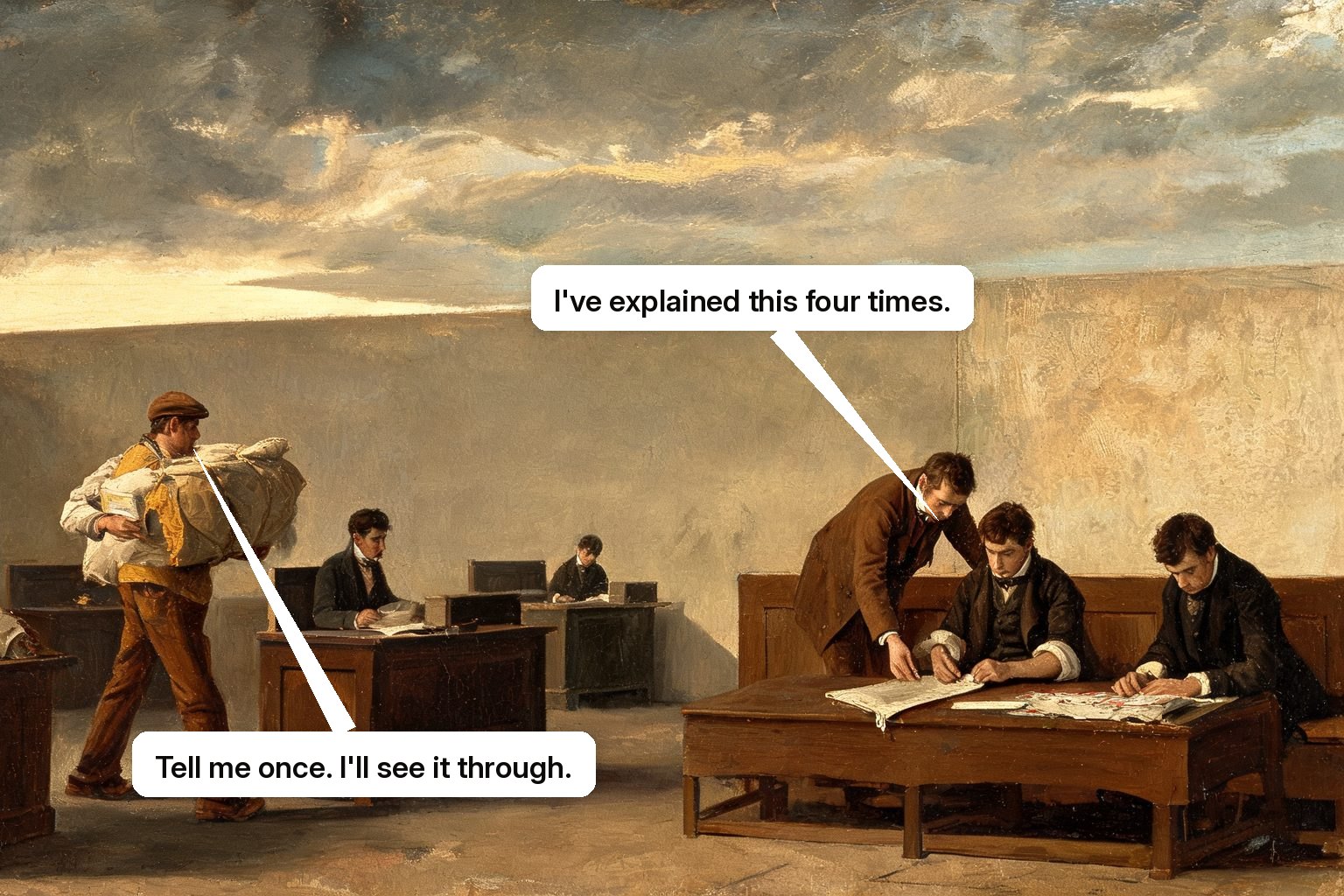
The customer lifecycle is one continuous relationship that most companies serve with five disconnected tools, and the customer pays the seams: re-explaining at every stage, context dying at every handoff. The full-lifecycle thesis says the compounding asset is memory, and one AI team that keeps it beats five point tools that each start from zero.
The seams are the product experience
Trace a customer through the standard stack: the demo tool that learned their use case hands nothing to the onboarding tool; onboarding's hard-won configuration knowledge is invisible to the support bot that meets them as a stranger in week six; the training platform schedules them a generic curriculum unaware of everything the other four systems know. Each tool may be excellent in its slice, that's not the failure. The failure is structural: every boundary is a place where the customer repeats themselves, and "let me transfer you" became the emblem of an entire industry's architecture. Buyers experience your org chart, seam by seam.
Why memory compounds, and fragments don't
Context is the rare asset that gains value with reuse. The use case learned in the demo makes onboarding start from reality; the configuration state from onboarding makes support diagnosis start at the problem; the ticket history makes training target what this team actually struggles with; the training record makes the renewal conversation evidence instead of vibes. Fragmented, each fact is collected once, used once, and re-extracted from the increasingly patient customer at every stage. Unified, each fact works every subsequent stage, compound interest on attention already paid. Point-tool architectures can integrate toward this, and integrations carry facts; what they don't carry well is the working memory, the agendas, the half-finished plans, the "we deferred this to next week", which is where the relationship actually lives.
What "one team" means beyond one vendor
The thesis isn't consolidation for procurement's sake; it's teammates. A team shares memory and hands work to each other: the agent that ran the demo briefs the one that onboards; the one that resolves a recurring issue tips the one that trains; all of them write to the systems your humans read. The retention story writes itself from the mechanics: users who were demoed, onboarded, supported, and trained by agents that remember the account are users whose renewal meeting contains no surprises, for either side.
The honest counterargument, and the bet
Best-of-breed's case is real: a point tool can out-feature a platform in its slice, and switching costs argue for incumbency. The bet is about where value concentrates as agents mature: in any single slice's polish, or in the memory that spans them. Everything in the last decade of software says seams lose eventually. (Disclosure: this thesis is Skippr, four agents, one memory, first demo to renewal, so weigh the argument knowing who's making it, and test it on the seam your customers complain about most.)
See what a live agent actually does
The category is easier to watch than to define. Fifteen minutes is enough to see where the mechanism differs from everything it gets confused with.