
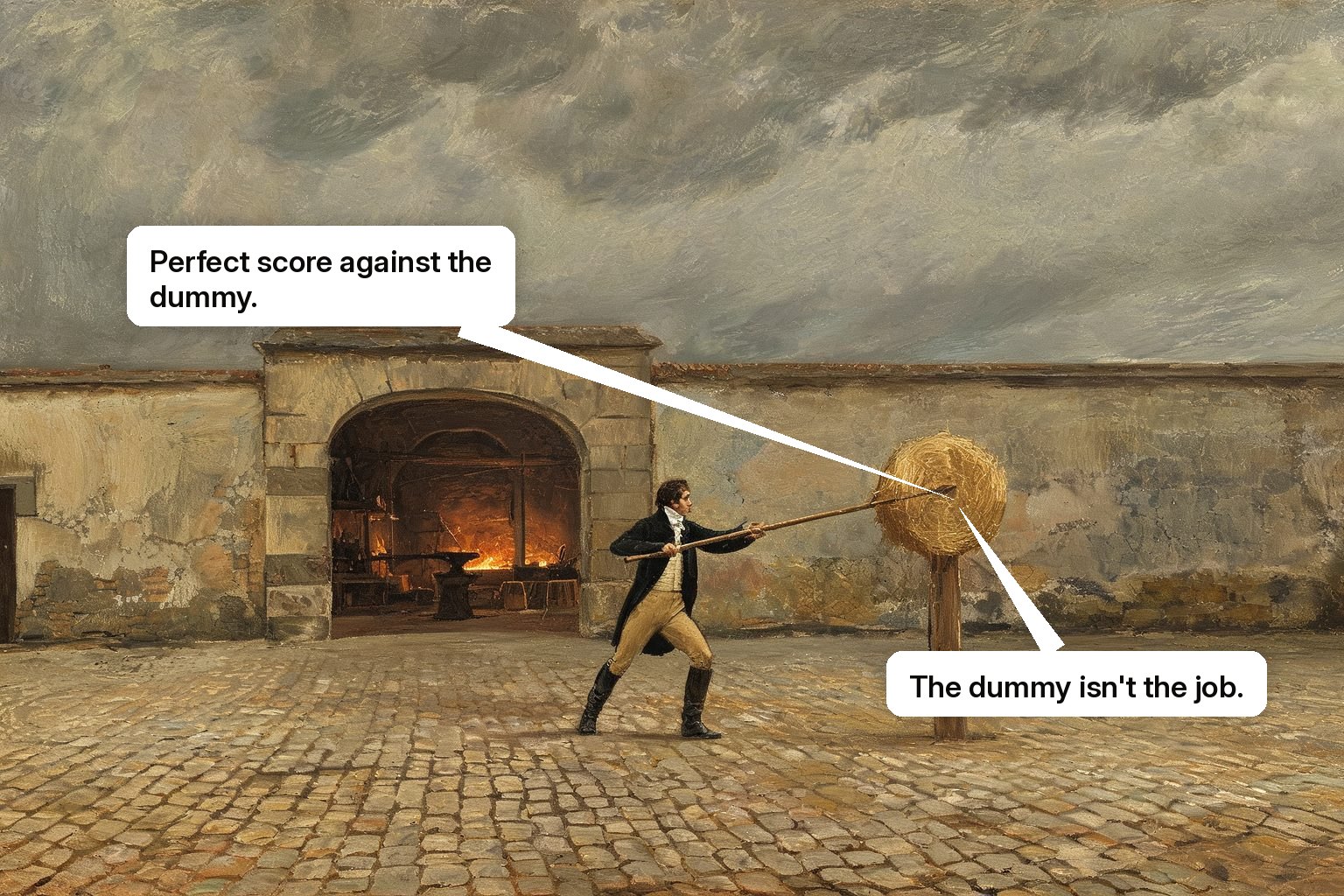
AI roleplay, practicing conversations with an avatar that talks back and scores you, is having a deserved moment in enablement, with major training platforms shipping live avatar practice in 2026. It's real progress on a real problem. It also answers only half the training question, because conversations are rehearsed with avatars, but software skills are built in software.
What avatar roleplay genuinely solves
Credit first: rehearsing high-stakes conversations, the discovery call, the objection, the difficult review, against an AI that pushes back, then getting scored against a rubric, beats reading a battlecard by a mile. Platforms like Synthesia have moved from training video into exactly this kind of live roleplay practice, and for conversational skills it's a sound mechanism: the practice context (a conversation) matches the performance context (a conversation). Transfer distance: short. Verdict: use it for talk tracks.
Where the mechanism runs out
Now try to roleplay your CRM. The moment the skill involves an interface, quoting, configuring, reporting, troubleshooting, an avatar conversation is practice about the task, not practice of it. The performance context isn't a dialogue; it's screens, states, clicks, and edge cases. Rehearsing a description of the workflow transfers about as well as describing swimming. This isn't a flaw in roleplay tools; it's a boundary. Conversational skills and procedural software skills are different animals, and each deserves practice in its native habitat.
The full training stack, honestly divided
Map the skill, pick the mechanism. Conversation skills (pitch, objection, negotiation): avatar roleplay, genuinely. Software skills (any workflow with an interface in it): hands-on practice in the live product, shown on the learner's screen, attempted in a safe practice mode, corrected in the moment, repeated across spaced sessions until it's demonstrated, not just discussed. The second mechanism is what a live in-product training agent provides: a trainer with eyes on the learner's screen and a session agenda per learner. (Disclosure: that's the half we build, Skippr's Skippr AI training, and we'd genuinely recommend roleplay tools for the other half.)
The one-question test for any training purchase
Ask: where does this skill get performed? If the answer is "in a conversation," rehearse the conversation. If the answer is "in the product," no rehearsal about the product substitutes for supervised reps inside it. Buy practice that happens where the performance happens, both kinds, if you need both. Most enablement teams do.
Watch it train someone
Completion is not competence, and the difference shows up in the product rather than the dashboard. Fifteen minutes is enough to tell them apart.