
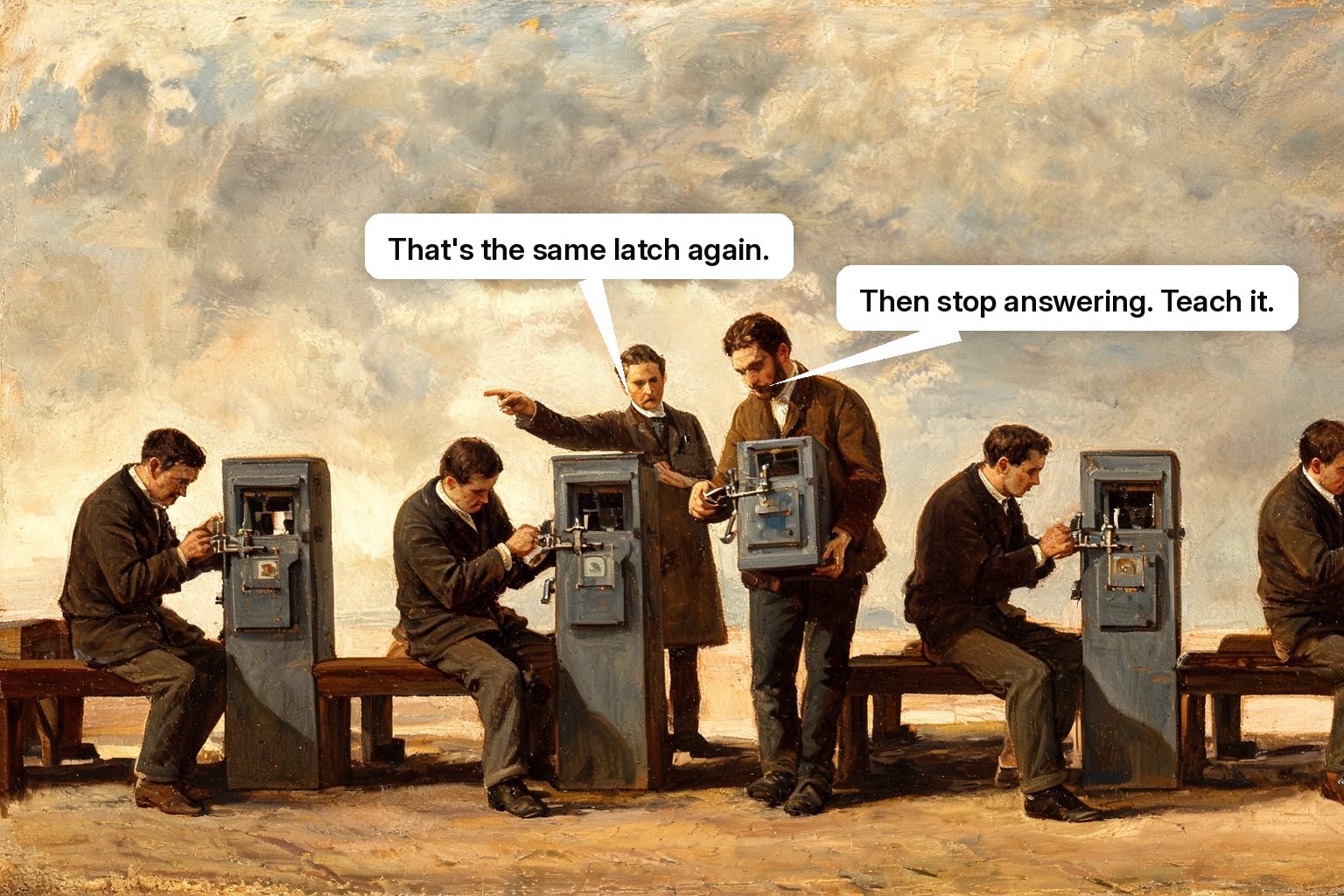
Every product has a "how do I" backlog: the same fifty questions, asked forever, answered one at a time by support, colleagues, and search. Answering them is a cost center; mining them is a curriculum. The teams that close the loop, repeat question in, training update out, are running the cheapest needs analysis in software.
What the backlog actually is
Strip the phrasing variety away and the how-do-I stream clusters hard: a handful of workflows generate most of the questions, per segment, per lifecycle stage, per release. Each cluster is a precise diagnosis with a return address. Asked in week one? Onboarding's agenda missed it. Asked in month four by trained users? The skill decayed, or the training never stuck. Asked in the week after a release? The change shipped without its lesson. Asked forever by everyone? The product owes a fix, and until then, the curriculum owes a lesson. Support teams see this stream all day; training teams, who could retire it, usually never see it at all, which is the organizational bug this whole playbook fixes.
How the loop runs, operationally
Four steps, monthly. Cluster: group the quarter's questions by workflow and segment, an agent that answers how-do-Is in-product arrives with this data structured; ticket exports get you most of the way otherwise. Rank: frequency times cost, the question that precedes churny behavior or a misconfigured deployment outranks the merely common. Route: each top cluster becomes its natural fix, a practice-mode scenario for procedural stumbles, an onboarding agenda item for week-one repeats, a launch-day session for release-driven spikes, a product ticket when the question is really a design apology. Retire: watch the cluster's volume after the fix ships; a lesson that works shows up as a question that stops being asked.
Why an in-product agent supercharges the loop
Three compounding advantages. Capture: every question is already tagged with its context, which screen, which state, which user segment, so clustering stops being archaeology. Immediate patching: the agent answers the question and offers the sixty-second supervised rep that stops it recurring for that user, retail-scale fixes while the wholesale fix ships. And closed-loop verification: because the same system answers questions and delivers curriculum, the retire step is measurable per lesson, question volume per workflow, before and after, per cohort.
The cultural shift hiding in the mechanics
Teams that run this loop stop treating repeat questions as user failure ("it's in the docs") and start treating them as the product's most honest feedback channel. The backlog never empties, releases refill it, but it stops accumulating, and the curriculum stops being guesswork. (Disclosure: Skippr's agents answer how-do-Is in-product and feed exactly this loop; the monthly ritual above works with whatever tooling you have.)
Questions buyers actually ask
Isn't this just building a better FAQ?
No, an FAQ answers the question again, better. The loop retires the question: a supervised rep in practice mode stops it recurring; an FAQ entry waits to be found.
Who owns the loop?
Training owns the routing and lessons; support owns the stream; product gets the clusters that are really design debt. The monthly review needs all three in the room.
How fast does question volume respond?
Release-driven clusters respond within weeks of a launch-day session; evergreen clusters fade over a quarter as cohorts pass through updated onboarding.
Watch it train someone
Completion is not competence, and the difference shows up in the product rather than the dashboard. Fifteen minutes is enough to tell them apart.