
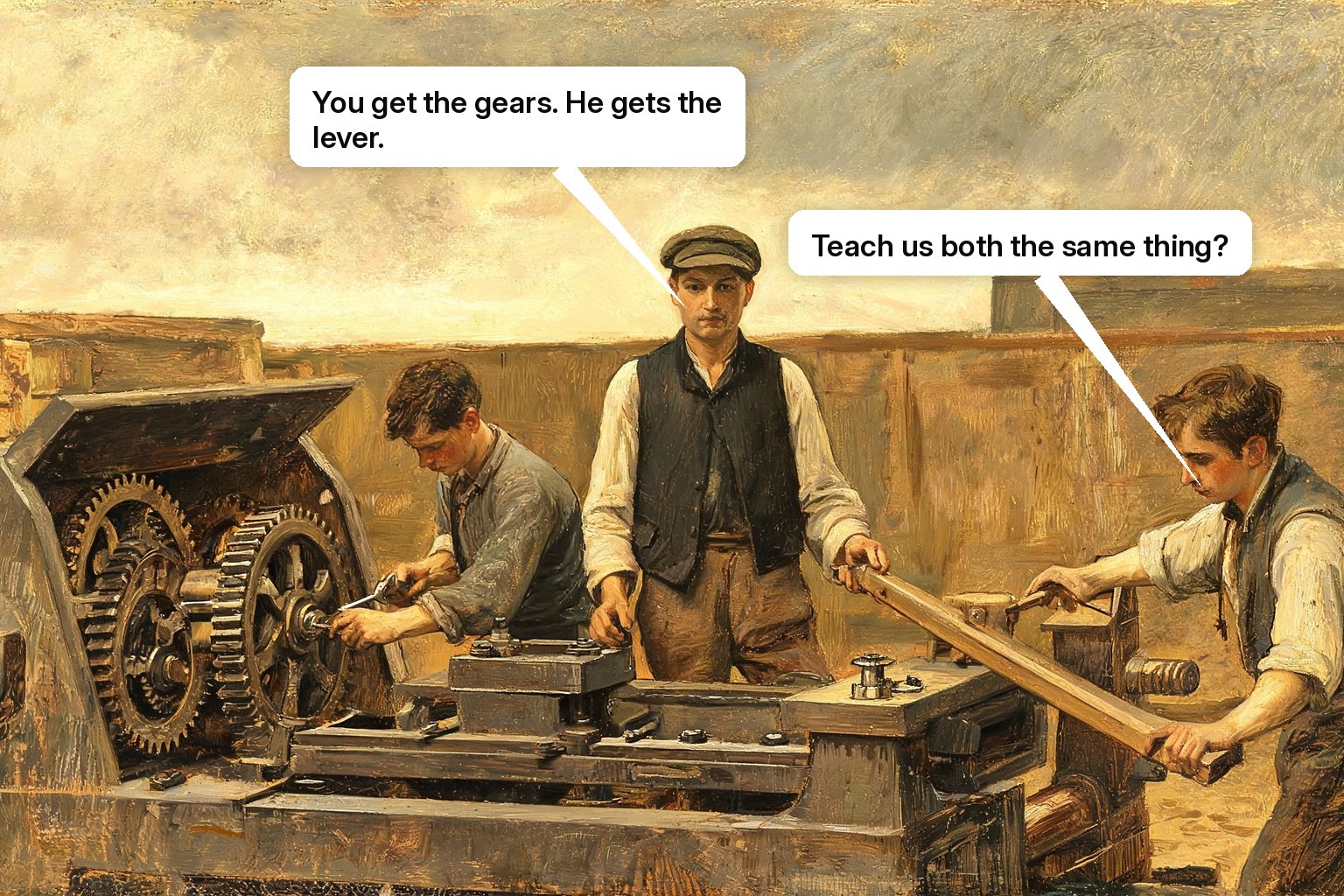
Admins and end users are learning different products that happen to share a login: one configures the machine, the other lives in its output. Training that averages the two audiences serves neither. The fix is two agendas, deliberately distinct in content, depth, and pacing, delivered by one agent that knows which it's talking to.
Why averaging fails both audiences
The blended curriculum is a compromise nobody asked for: end users sit through permission models they'll never touch (and learn to skip training entirely, a habit that outlasts the session), while admins get a workflow tour that never reaches the configuration depth their job actually needs. The damage is asymmetric but mutual, bored end users disengage from all future training; under-trained admins become the single point of failure the whole account leans on, fielding questions they were never properly taught to answer.
What belongs in each agenda
The admin agenda is a systems curriculum: configuration done hands-on, integration architecture, permission modeling with the reasons attached, the maintenance rhythms (what breaks, what drifts, what the audit needs), and the exception paths, because admins are who everyone asks when the weird case appears. Depth over breadth, verified by performing the real setup tasks unassisted. The end-user agenda is a workflow curriculum: the handful of role-relevant flows done fluently, the efficiency layer (the shortcuts that separate daily users from strugglers), and just enough conceptual model to self-orient, breadth of confidence over depth of internals, verified by performing their actual daily work. The two overlap almost nowhere, which is the point.
What "one agent" adds to "two agendas"
Coherence. The agent sees the account's real state, so end-user sessions reference what the admin actually configured (not a generic setup), and admin sessions know which workflows the team actually runs. Questions route sensibly: the end user who asks an admin-shaped question gets the answer plus a note in the admin's next session, instead of a shrug. And the account's competence map reads as one picture, admin track, user track, per person, per workflow, so CS sees "configured but untrained team" or "trained team, shaky admin" at a glance, two different risks with two different fixes.
Sequencing the two tracks
Admin first by dependency, but only just: start end-user sessions as soon as their workflows exist, rather than after the admin finishes everything, activation is a system property, and a fully configured account with an untrained team is a renewal risk wearing a green checkmark. (Disclosure: per-role agendas on one account plan are how Skippr's training agent works; the split above is the design worth keeping whoever delivers it.)
Questions buyers actually ask
What about the admin who's also an end user?
Common in small teams: the tracks merge into one sequenced agenda for that person, configuration depth first, workflow fluency after, without averaging the content.
Should managers get a third agenda?
Usually a slim one: the reporting views and the adoption picture, scheduled once there's real data to show. It's closer to the end-user track than the admin one.
How is this different from role-based course tracks in an LMS?
The agendas here are live sessions on the account's real configuration, with supervised practice and verified performance, not two playlists of the same genre of video.
Watch it train someone
Completion is not competence, and the difference shows up in the product rather than the dashboard. Fifteen minutes is enough to tell them apart.