
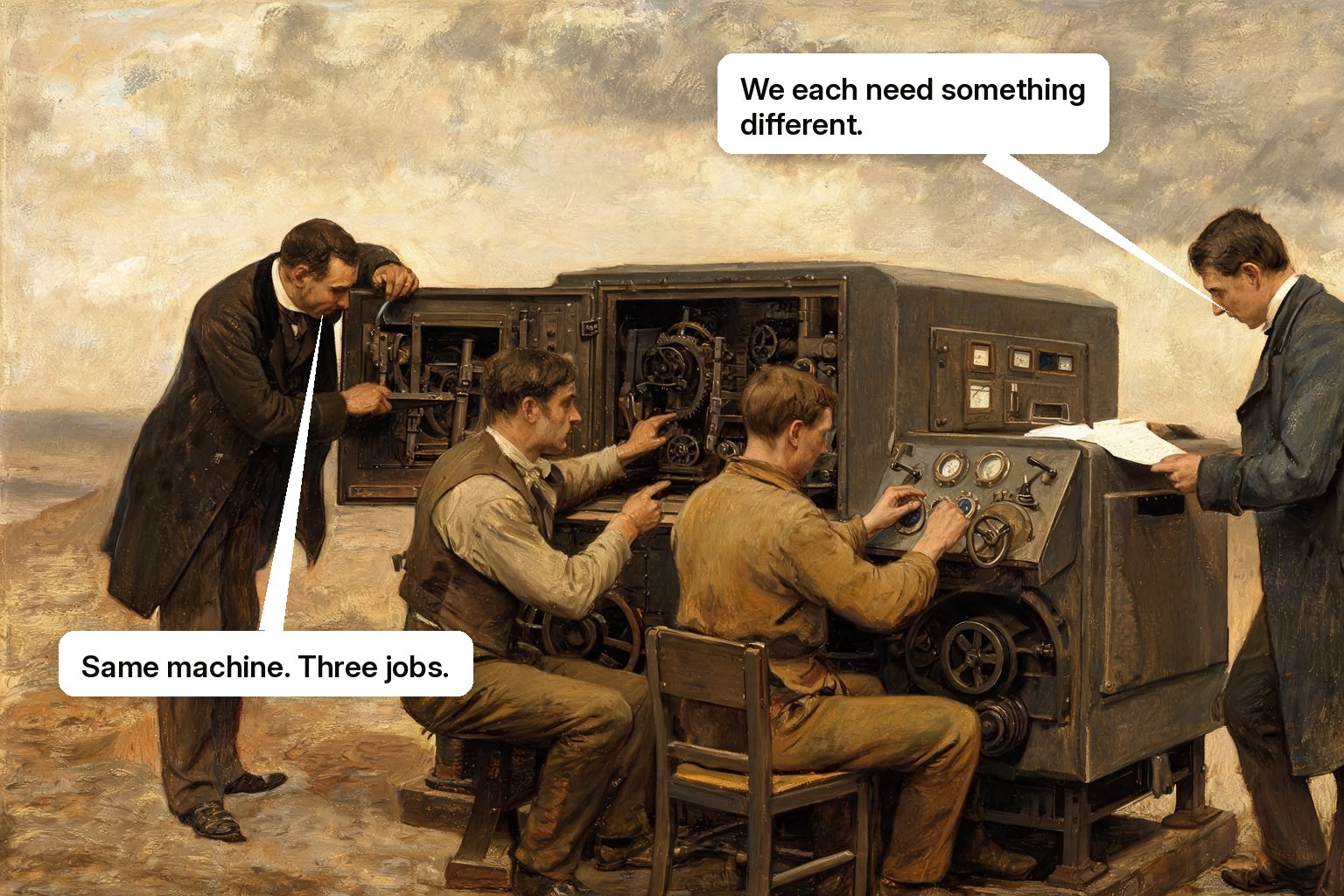
A B2B account isn't a user; it's a cast. The admin who configures, the manager who reads the reports, the end users who live in the workflows, each needs a different onboarding, and most programs deliver one generic path to all of them. Multi-stakeholder onboarding means one account plan with a distinct agenda per role, run in parallel.
Why does one-path onboarding fail accounts?
Because the roles fail differently. The admin who never finishes configuration blocks everyone downstream. The manager who never sees value in the dashboards quietly stops sponsoring the tool. The end users who never learn the workflows generate the tickets, the workarounds, and eventually the renewal conversation nobody enjoys. A single onboarding path optimized for "the user" hits none of these targets: it's too shallow for the admin, too mechanical for the manager, and too configuration-heavy for the end users, who needed the workflow story all along.
What does a per-role agenda structure look like?
One account plan, three tracks. Admin track: configuration done together on their screen, integrations connected, permissions modeled, the technical spine, front-loaded because everything else waits on it. Manager track: shorter, value-focused, the reports that answer their questions, the adoption view of their team, scheduled after enough data exists to be honest. End-user track: workflow sessions in role-relevant slices, spread across the first week, practice included. The tracks reference each other, the agent doesn't ask end users to configure what the admin already set up, because it can see the account's actual state, and the plan tracks account-level milestones, not per-person checkbox completion.
How does parallel delivery change the economics?
Human-led onboarding serializes: the specialist runs the admin call, then maybe a manager call, and end users get a webinar link, rationing by role. A live agent runs every track simultaneously, each person getting their session on their screen, in their language, at their moment, and the account activates as a system rather than as one trained admin surrounded by confused colleagues. The train-the-admin pyramid, where one person absorbs the vendor sessions and everyone else learns by osmosis, stops being the default because its economic excuse is gone.
What should you watch per account?
Track completion per role, not just account activation: an account with a finished admin track and an untouched end-user track is a renewal risk wearing a green checkmark. Watch also the cross-role gaps, configured features nobody uses point at the manager and end-user tracks, not the admin. (Disclosure: multi-track account agendas are how we designed Skippr's onboarding agent; the role-split design applies whatever platform runs it.)
Questions buyers actually ask
Who gets onboarded first?
The admin track leads by dependency, the account's spine, with end-user sessions starting as soon as the relevant workflows are configured, not after everything is.
What about tiny accounts where one person is all three roles?
The tracks collapse into one sequenced agenda for that person, configuration first, value story last, which is still better than a generic path.
How do executives fit in?
A fourth, minimal track when it matters: one short value-framing session, scheduled when there's real usage to show.
Watch it onboard someone
Onboarding either happens on the user's own screen or it does not happen. Fifteen minutes is enough to see which one you are buying.