
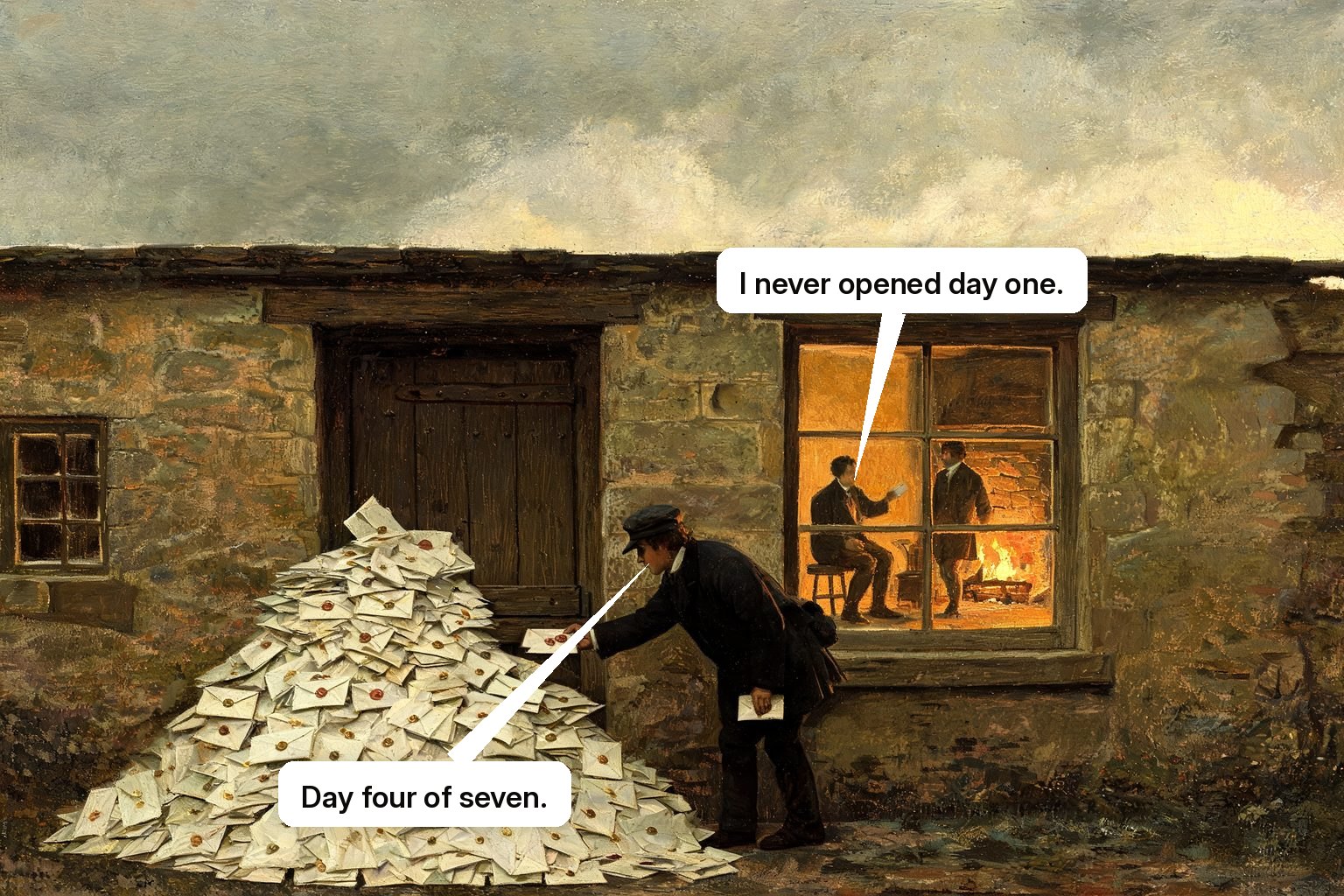
Open your onboarding email sequence's analytics and read the truth: most of your new users are not reading your carefully sequenced advice. The drip campaign was never onboarding, it was onboarding's apology, sent daily. Sessions get accepted because they do the thing; emails get archived because they describe it.
The inbox is where onboarding goes to be ignored
The onboarding email arrives in the one place your product isn't: the inbox, competing with everything else in the user's day, days after the moment it describes ("Ready to connect your data?"; they tried on Tuesday, got stuck, and left). Open rates round down to disappointment; click-throughs round down further; and the emails that do get read are read as marketing, because that's what the channel means to people now. None of this is your copywriter's fault. The medium is positionally wrong (not in the product), temporally wrong (not at the moment of need), and mechanically wrong (it can describe actions but perform none of them).
Why sessions get accepted
A session is an offer of work done together: fifteen minutes, on your screen, and the thing will exist when we're done. It happens in the product, where the user's intent already is. It happens at the user's moment, signup, first stall, their 9 p.m., not the campaign's day-three slot. And it acts: forms filled, integrations connected, the workflow actually run, which is the difference between advice and help. Users don't accept sessions out of politeness; they accept them because the value is legible before it starts. Nobody's inbox filter has ever eaten a session that was already helping.
What email is still for
Not nothing, but not teaching. Email remains right for the things it's structurally good at: the summary after a session (a record the user can forward internally), the receipt, the escalation a human sent personally. Demote it from instructor to messenger and its numbers stop mattering, because nothing important rides on them anymore. The instructive load, the guiding, the configuring, the pacing across the first week, belongs to a medium that can see the screen and do the work: a live session with an agenda. (Disclosure: that medium is what we build at Skippr; the argument stands wherever you buy it.)
The test your own data will pass
Pull two numbers for last quarter's cohort: the share of signups who clicked through onboarding email three, and the share who accepted a session offer made in-product at a stall. If you don't have the second number yet, that's the experiment worth running this month, and the gap between the two is the size of the apology you've been sending.
Watch it onboard someone
Onboarding either happens on the user's own screen or it does not happen. Fifteen minutes is enough to see which one you are buying.