
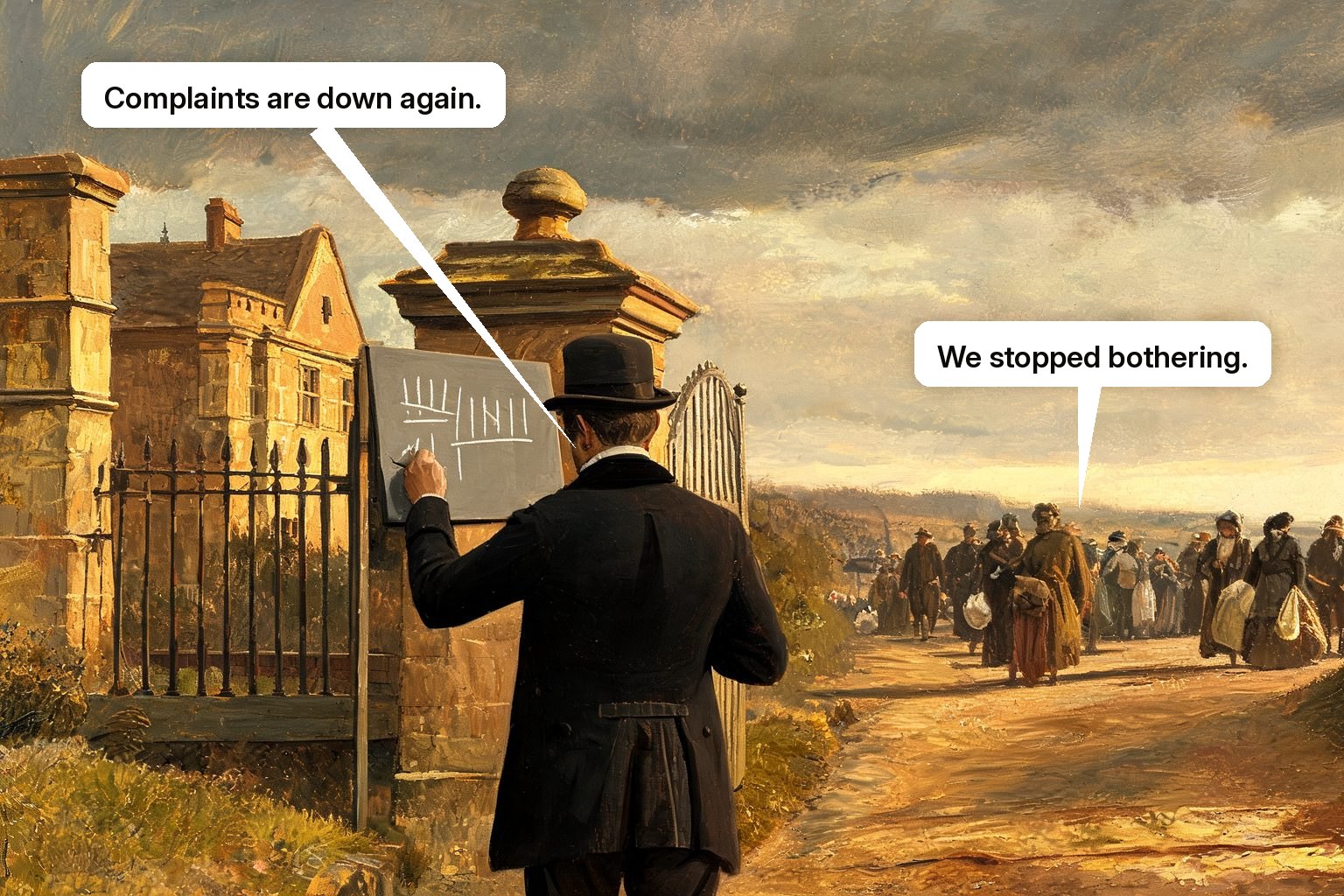
Deflection is the support metric that can lie to you with a straight face. Tickets are down, the dashboard is green, the AI vendor's QBR slides are triumphant, and somewhere outside your measurement, users who never got helped are quietly deciding not to renew. Fewer tickets is only good news if the problems actually got solved.
How deflection became the metric, and what it hides
Deflection was born honest: in a world of expensive human queues, every question answered by an article was real money saved. AI support made it explosive, modern agents genuinely resolve a large share of routine conversations, and deflection rates became the category's headline number. The trap is in the accounting: deflected means "didn't become a ticket." It does not mean "solved." The user who got an article, tried it, failed, and gave up? Deflected. The user who rage-closed the chat? Deflected. The user who worked around the broken feature and downgraded at renewal? Beautifully, invisibly deflected. The metric counts absences and calls them outcomes.
The silent-failure cohort
Support leaders eventually meet the ghost in the numbers: churn among accounts with low ticket volume and unresolved friction. They stopped asking, the most dangerous customer state there is, because silence reads as satisfaction in every dashboard you own. A deflection-maximizing stack actively grows this cohort: each friction-filled self-service loop teaches users that asking is expensive, so they stop, and the metric improves as the relationship decays. You end up optimizing for the appearance of no problems rather than the absence of problems.
Resolution accounting: the honest alternative
The fix is to change what counts as success: not "conversation didn't escalate" but "user's problem verifiably solved", task completed, error gone, workflow running, confirmed on the actual screen where it happened. That standard is demanding, and that's the point. It naturally favors support that can see the problem state and act on it (a misconfiguration fixed on-screen is a resolution; a link to the configuration doc is a coin flip), and it pairs deflection's cost story with the metric deflection forgot: did the customer end up okay? Watch resolution rate, reopen rate, and post-support retention next to deflection, and the trap loses its teeth. (Disclosure: Skippr's Skippr AI technical support is measured on resolutions, the number we'd want to be judged on, and the one worth demanding from any vendor's QBR, including ours.)
One question for your next support review
Pull ten "deflected" interactions at random and answer honestly: how many of those users actually got where they were going? That sample, not the dashboard, is your real support quality. If the answer embarrasses the green number, you've found the trap, before it found your renewals.
See it handle a real question
A support answer either resolves the thing or describes it. Fifteen minutes is enough to see which one you are getting.