
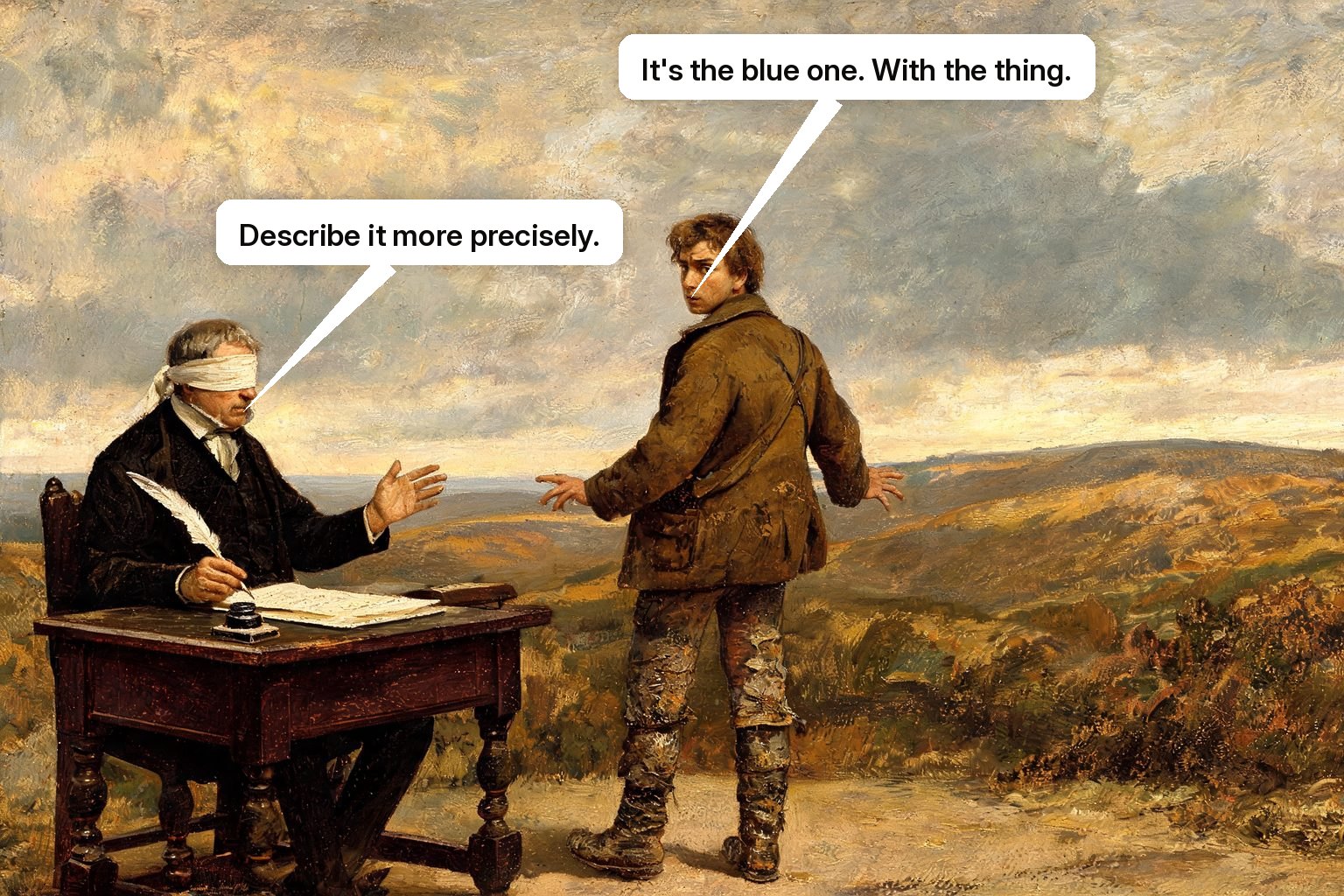
Every support interaction that begins with "can you describe what you're seeing?" is a small confession: our support system is blind, so we've deputized the confused customer as its eyes. That sentence, along with its cousins (the screenshot request, the "which page are you on?"), is the clearest tell that a support stack belongs to the previous era.
The absurd job we gave the customer
Think about what the blind-support workflow actually asks. The person least equipped to describe the product, the confused user, mid-failure, often mid-frustration, is asked to translate a visual, stateful situation into prose, using vocabulary they don't have, for an agent who will then guess at a mental reconstruction. Then both parties debug the description before they can debug the problem. Screenshot ping-pong follows: capture, crop, upload, "no, the other settings page." Whole minutes of every ticket are spent building a shared picture that one glance would have provided. We normalized this because there was no alternative. There is now.
Why text support inherited blindness, and why it stopped being necessary
Chat and email support were built on a channel that carries words, so the entire discipline evolved around words: canned responses, macros, article links, sophisticated systems for answering descriptions. AI supercharged the words (faster answers, better retrieval) without fixing the input: the model still acts on the user's guess about what's on screen. Screen-aware support inverts it. The agent sees the actual interface, the real page, the real state, the real error, with the user's consent, and the diagnostic conversation starts from truth instead of testimony. "Describe what you see" becomes "I can see it, let's fix it," and the fix can happen right there on the screen, guided or performed, not mailed back as step-by-step instructions to be re-translated.
The dividing line for the next few years
Support stacks will split into two families: those that process descriptions and those that see problems. The first family will keep getting better at answering, and keep paying the blindness tax on every ticket where the answer depends on state the user can't articulate. The second family collapses that entire category: misconfigurations diagnosed on sight, fixes walked through on the live screen, escalations handed to humans with the diagnostic picture attached instead of a transcript of mutual confusion. (Disclosure: Skippr's Skippr AI technical support is built in the second family, and the audit question travels well: how many of your tickets this month began with the customer describing their screen? That number is the size of your opportunity.)
See it handle a real question
A support answer either resolves the thing or describes it. Fifteen minutes is enough to see which one you are getting.