
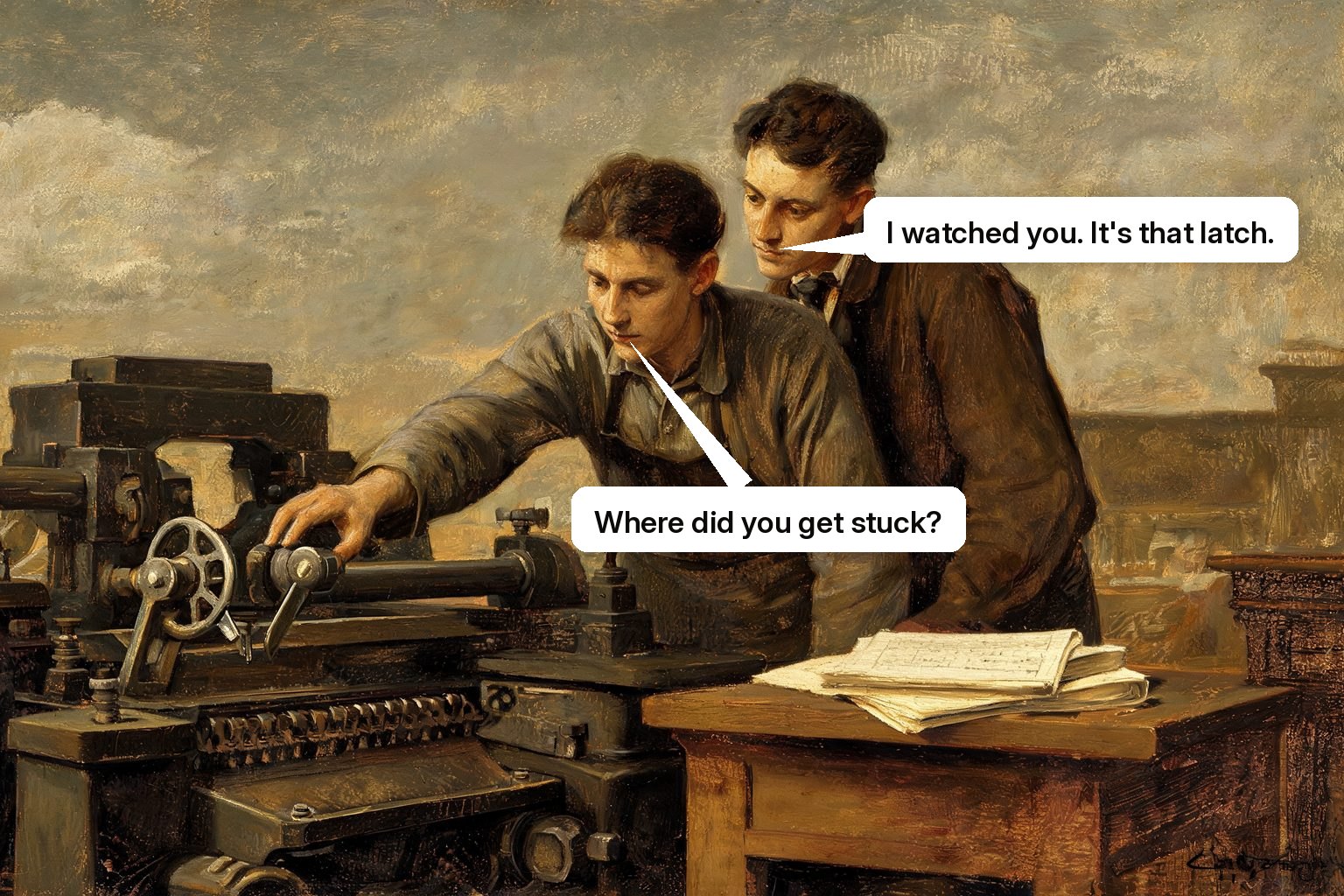
Every onboarding retro asks users the same question: where did you get stuck? It arrives by survey, by exit interview, by CSM call, always after the fact, always answered from memory, always by the users who bothered to reply. It is the wrong question, because the truthful answer was visible on the screen at the moment it happened, and nothing was looking.
Why the question fails even when users answer it
Self-reported friction is a reconstruction, and reconstructions lie politely. Users misremember which step confused them, blame themselves for design failures, forget the four small hesitations that preceded the one big abandonment, and describe symptoms in vocabulary the product team must then decode. Worse, the sample is survivorship all the way down: the users who churned at the sticking point are precisely the ones who never see the survey. Product analytics fills some gaps (drop-off funnels, rage-click detection) but analytics sees actions without context; it knows the user left the integrations page in ninety seconds and cannot know they left confused, satisfied, or interrupted by lunch.
What changes when something is watching that can help
A screen-aware onboarding agent dissolves the question, twice. In the moment: the agent sees the hesitation as it happens (the cursor circling, the form half-filled, the error thrown) and intervenes right there, by voice, on the live screen. The stuck moment gets resolved instead of survey-ed. After the fact: because every session runs through the agent, friction stops being anecdote and becomes a corpus: which step, which segment, which phrasing of which question, at what frequency, with what resolution. The onboarding retro changes character completely; instead of asking users to remember pain, the team reads a ranked list of observed pain, with recordings of the fix that worked.
The deeper shift: from interrogation to attention
There is something quietly absurd about the old model: we built products too complex to use unaided, gave users no aid, then asked them to file field reports on their own confusion. The question "where did you get stuck?" was never really a research method; it was an apology for absence. Attention is the replacement. A colleague standing next to you never needs to ask where you got stuck; they saw, and they helped, and the getting-stuck mostly never finished happening. That is the standard live agents restore, at software scale. (Disclosure: this is what we build at Skippr; Skippr AI onboarding's sessions are exactly this kind of attention, and the friction corpus they produce is the retro your product team always wanted.)
Retire the question gracefully
Keep the survey if you like the ritual, but demote it. The primary friction feed should be observation: real sessions, real screens, real interventions, aggregated. Teams that make the switch discover the most expensive fact in onboarding: most stuck moments were never reported by anyone. They were just quietly fatal.
Watch it onboard someone
Onboarding either happens on the user's own screen or it does not happen. Fifteen minutes is enough to see which one you are buying.