
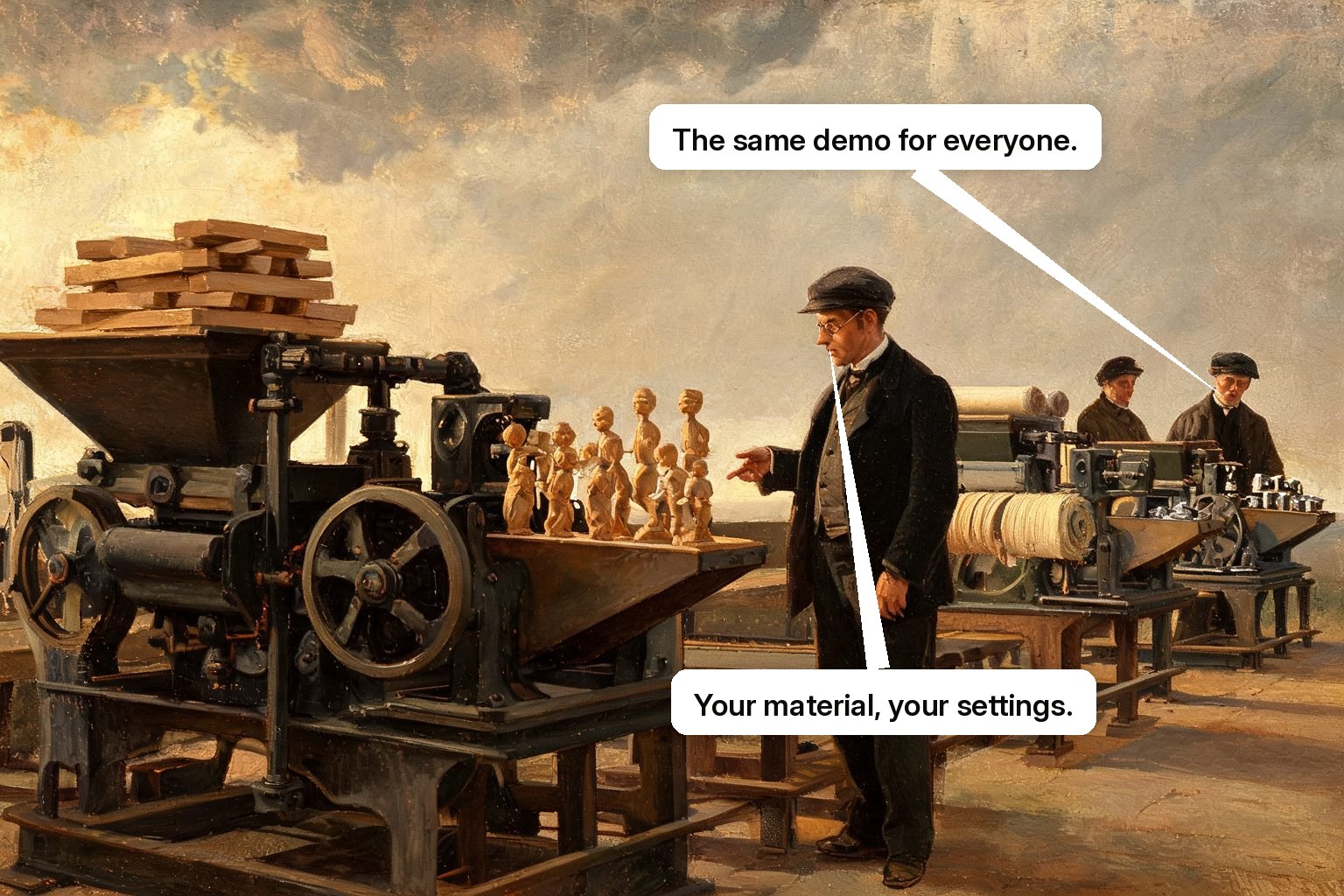
For a decade, "personalized demo at scale" meant inserting the prospect's logo and industry screenshots into a templated tour. Real personalization is behavioral: what gets shown, in what order, at what depth, responding to what this buyer says and does. AI makes the second kind scalable for the first time.
The two personalizations, and why the difference matters
Cosmetic personalization changes the wrapper: name, logo, vertical-flavored data. Substantive personalization changes the demo itself: an ops leader gets the workflow automation story first, a security reviewer gets the permissions model at depth, a switching buyer gets the migration path, each in their own language, each at their own pace. Buyers feel the difference immediately, because cosmetic personalization still ignores their questions; it just ignores them with their logo on screen. Substantive personalization was never a content problem. It is a listening problem, which is why templating tools plateaued at cosmetics.
How a live agent personalizes: perceive, then adapt
A live AI demo agent personalizes on three inputs. What the buyer says: stated role, use case, and stack reorder the agenda in real time. What the buyer does: lingering, skipping, and repeated questions adjust depth mid-session. What the account context provides: CRM history, prior sessions, and known segment shape the starting agenda before a word is spoken. The output is not a variant chosen from a library; it is a session steered continuously, the way a human SE personalizes, minus the calendar constraint. And because the agent remembers the account, personalization compounds: the second session starts where the first ended rather than re-personalizing from scratch.
Scale without a content factory
The templating model scales personalization by multiplying artifacts: per-vertical tours, per-persona videos, a library someone must maintain against every UI change. The agent model scales it by multiplying sessions: one agent, grounded in your product and knowledge base, running thousands of simultaneously different demos with nothing rendered in advance and nothing to go stale. The content team stops manufacturing variants and starts curating knowledge and agendas, which is both a smaller job and a more strategic one. (Disclosure: we build Skippr; Skippr AI demo is this mechanism, and you can test the claim self-service on a real page.)
Measure personalization by its outcome
The honest metric is not "variants produced" but relevance felt: session depth, question rate, demo-to-meeting conversion, and the share of sessions where buyers went past the standard agenda. Personalization that scales shows up as buyers staying longer and booking more, segment by segment, in numbers you already track.
Questions buyers actually ask
Does substantive personalization require heavy setup per segment?
No. It requires good grounding (product, docs, playbooks) and clear agenda goals; the per-buyer variation is the agent's job, not an authoring task.
Can this work for regulated or sensitive demos?
Yes, with scoped knowledge and explicit guardrails on what the agent may show or claim, reviewed like any sales collateral.
See it rather than read about it
The difference between a recording and a live agent is hard to argue and easy to watch. Fifteen minutes is enough to judge whether it fits your motion.