
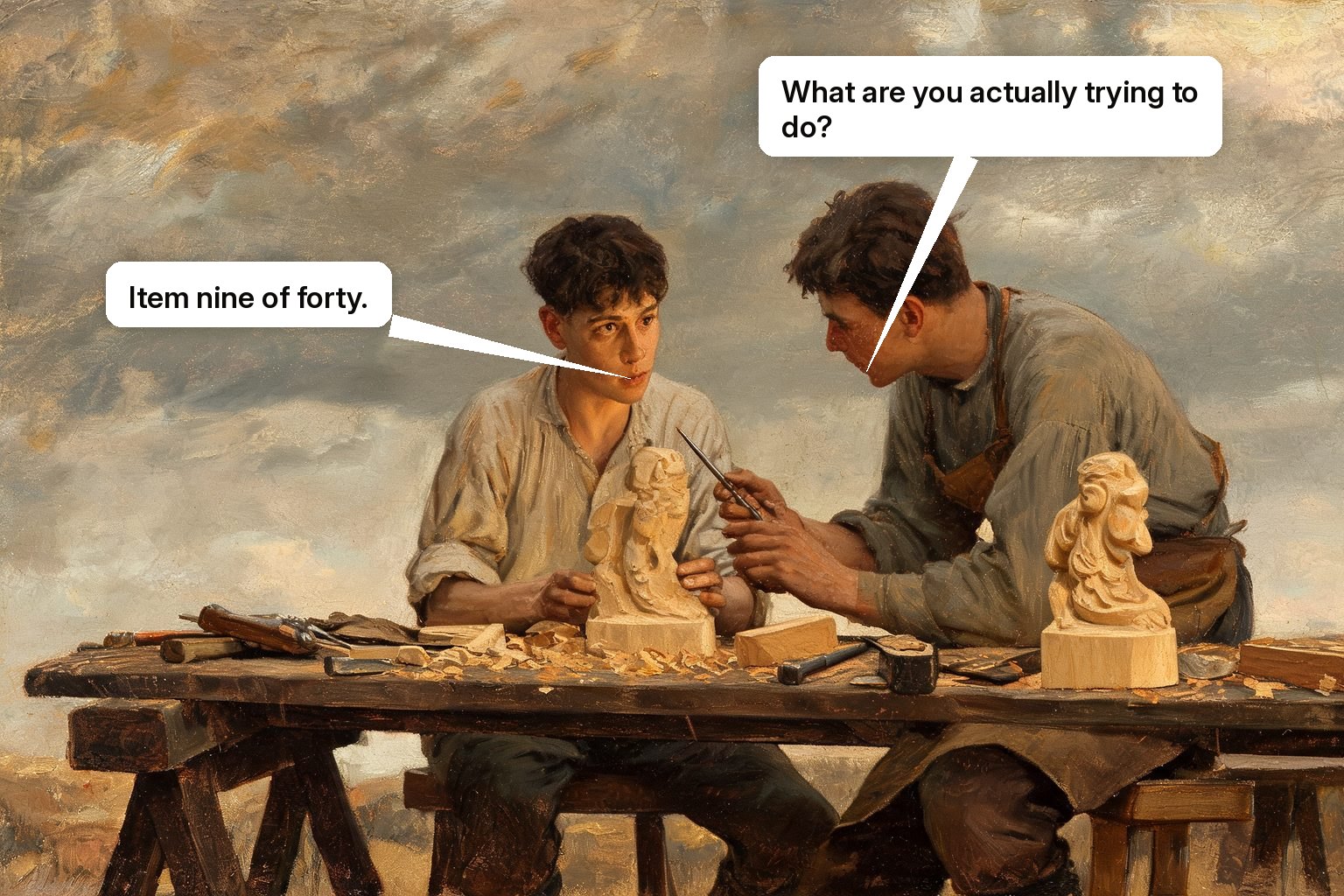
Open any SaaS product on day one and you will meet the same greeter: a checklist. Five items, a progress ring, a prize of confetti. The checklist is tidy, measurable, and profoundly alone. It hands the new customer a to-do list for a product they do not understand yet, then leaves. The first week deserves a colleague instead.
What the checklist actually communicates
Product teams read checklists as guidance. Customers read them as assignments. The subtext of every empty progress ring is: there is work to do here, you must figure it out, and the software will be keeping score. For confident users on simple products, fine. For everyone else, the checklist quietly converts the most hopeful moment of the relationship (someone chose your product to solve a real problem) into homework anxiety. And when an item confuses, the checklist has nothing to say; it is a list, and lists do not answer questions. The mechanism communicates exactly what it is: instructions in the absence of anyone.
What a colleague does differently in week one
Think about the best first week you ever had at a job. Someone sat with you. They asked what you were there to accomplish, showed you the parts that mattered for that, did the first real task with you, checked back in on day three, and remembered what you told them on day one. Every element of that experience has an operational translation: a kickoff conversation instead of a static list; a plan shaped to this customer's goal instead of five generic items; the first workflow done together on the real screen instead of linked in a doc; short sessions spread across the week instead of one overwhelming dump; memory carried between sessions instead of amnesia. None of this is exotic. It is what a good human onboarding specialist always did, for the accounts that got one. The change is that an agenda-driven live agent can now do it for every account, which turns week-one design from content strategy into relationship design.
The metrics tell the same story
Checklists optimize completion of the checklist; the correlation with actual activation is famously loose, because clicking through five items is not the same as reaching value. Colleague-style onboarding optimizes the thing itself: the workflow performed, the milestone confirmed on the customer's own data, the next session already scheduled with its purpose known. When week one is a working relationship, activation stops being an inferred metric and becomes a witnessed event. (Disclosure: we build Skippr, and Skippr AI onboarding is the colleague this essay describes: voice, eyes on the screen, an agenda that spans the week, and a memory that does not reset at midnight.)
A design exercise for your team
Rewrite your current onboarding checklist as dialogue: for each item, what would a good colleague say while doing it with the customer, and what would they ask first? If an item cannot survive translation into a conversation, it probably should not be in week one at all. The exercise takes an hour and usually redesigns the week.
Watch it onboard someone
Onboarding either happens on the user's own screen or it does not happen. Fifteen minutes is enough to see which one you are buying.