
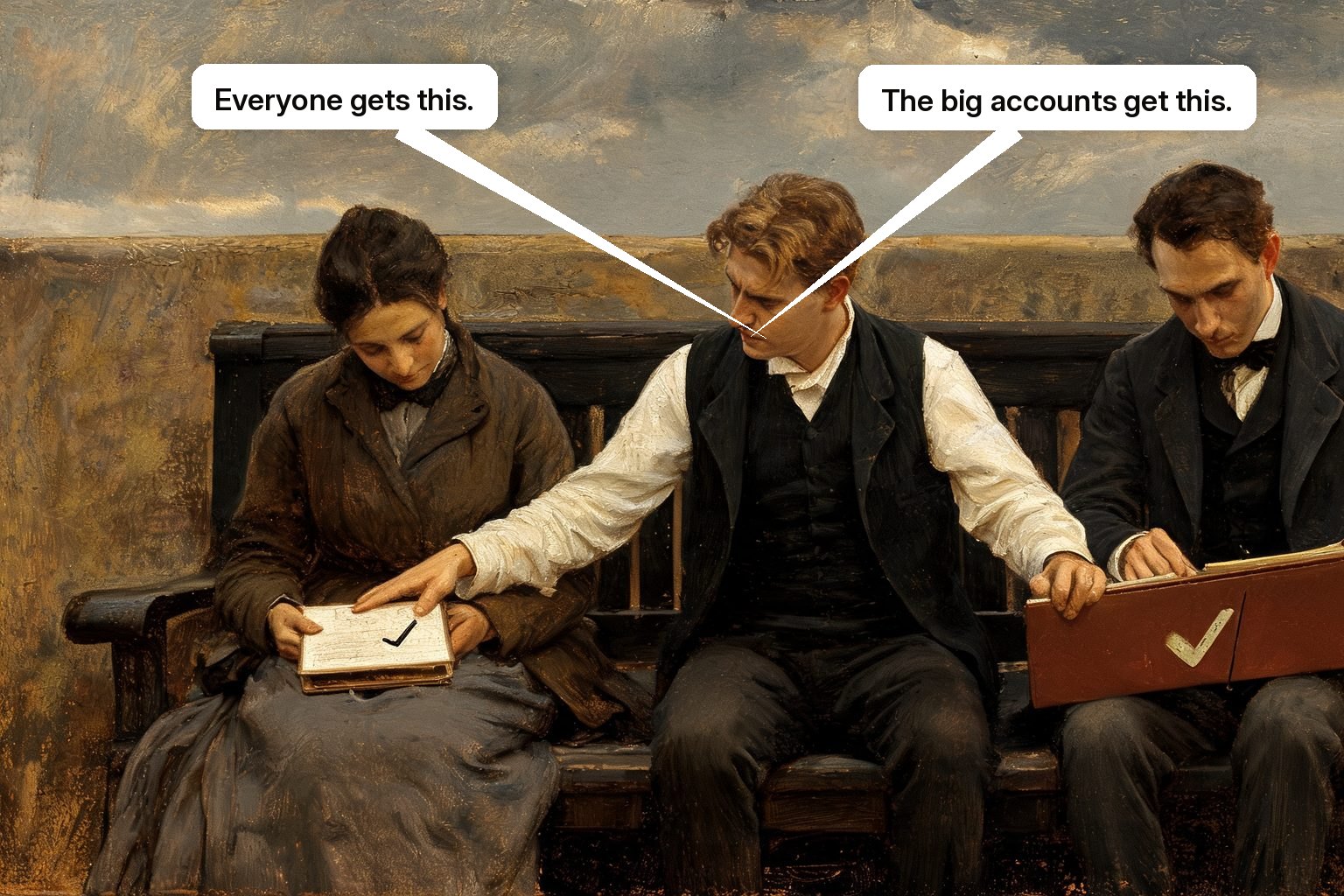
Every SaaS company runs a class system it never announced. Enterprise accounts get white glove: named specialists, guided implementations, patient humans on calls. Everyone else gets economy: automated emails and a help center. The split was never a values choice; it was arithmetic. The arithmetic just changed, and the class system deserves to end with it.
The system nobody defends but everybody runs
No onboarding leader has ever stood up and argued that small customers deserve worse help. The tiering emerged from a constraint: guided onboarding cost human hours, human hours were scarce, so they went to the largest contracts. Reasonable, given the constraint. But notice what the industry then did: it dressed the constraint up as strategy ("high-touch for enterprise, tech-touch for SMB"), built playbooks around it, and stopped noticing that "tech-touch" was mostly a euphemism for "no touch with better branding." The customers who needed the most help (smaller teams, fewer internal experts, no admin to lean on) systematically received the least. That is the class system: not malice, just math, calcified into best practice.
What ended the arithmetic
A live AI onboarding agent breaks the scarcity that created the tiers. The session that once required a scheduled human (a voice conversation, guidance on the customer's own screen, setup done together, a plan across the first days) can now be delivered to every account simultaneously, in any language, at whatever hour the customer actually works. The marginal cost of one more guided onboarding collapses toward software economics, and with it collapses the only honest justification the class system ever had. What remains is a choice: keep the tiers out of habit, or give every customer the first week that only your largest logos used to get. White glove stops being a tier name and becomes a default.
What "for everyone" has to mean in practice
Two tests keep the phrase honest. The first is coverage: the free-trial user at a five-person company gets a real session (voice, screen, plan), not a downgraded facsimile; the enterprise account keeps its human for the moments humans are genuinely better, with the agent absorbing the repeatable layer at every tier alike. The second is access: a platform claiming to end the class system cannot itself be sold like a class system. If guided onboarding for everyone is only available behind a six-figure quote and a sales cycle, the tiers just moved up a level. Self-service entry, published pricing, and a free way to start are not go-to-market details here; they are the claim's integrity test. (Disclosure: we build Skippr this way on purpose: free pilot, published plans, and the same agents serving both ends of the market, with enterprise depth (SSO, SLAs, certifications) when accounts grow into it.)
The ending worth writing
Industries occasionally get to retire an inequity that everyone had accepted as physics. Onboarding is having that moment. The company that ends its class system first does not just improve a metric; it changes what its smallest customers believe the relationship is. And customers remember who treated them like enterprise before they were one.
Watch it onboard someone
Onboarding either happens on the user's own screen or it does not happen. Fifteen minutes is enough to see which one you are buying.